
Ch. 7 - Hypothesis Testing with One Sample
Larson - Elementary Statistics: Picturing the World 8th Edition
Larson8th EditionElementary Statistics: Picturing the WorldISBN: 9780137493470Non è quello che usi tu?Cambia libro di testo
Capitolo 7, Problema 7.RE.10d

In Exercises 7–10, (d) explain how you should interpret a decision that rejects the null hypothesis.


An energy bar maker claims that the mean number of grams of carbohydrates in one bar is less than 25.

Guida verificata passo dopo passo
1
Step 1: Understand the null hypothesis (H₀) and the alternative hypothesis (H₁). The null hypothesis (H₀) represents the claim being tested, which in this case is that the mean number of grams of carbohydrates in one energy bar is greater than or equal to 25. Mathematically, H₀: μ ≥ 25. The alternative hypothesis (H₁) represents the claim made by the energy bar maker, which is that the mean number of grams of carbohydrates in one energy bar is less than 25. Mathematically, H₁: μ < 25.
Step 2: Determine the significance level (α) for the hypothesis test. This is typically provided in the problem or chosen by the researcher (e.g., α = 0.05). The significance level represents the probability of rejecting the null hypothesis when it is actually true.
Step 3: Conduct the hypothesis test using the appropriate statistical method. Since the claim involves the mean and a comparison to a specific value, you would likely use a one-sample t-test if the population standard deviation is unknown, or a z-test if the population standard deviation is known. Calculate the test statistic using the formula for the chosen test. For a t-test, the formula is: x̄−μsn, where x̄ is the sample mean, μ is the hypothesized mean, s is the sample standard deviation, and n is the sample size.
Step 4: Compare the test statistic to the critical value or use the p-value approach. If the test statistic falls in the rejection region (or if the p-value is less than α), reject the null hypothesis. Otherwise, fail to reject the null hypothesis.
Step 5: Interpret the decision. If you reject the null hypothesis, it means there is sufficient evidence to support the energy bar maker's claim that the mean number of grams of carbohydrates in one bar is less than 25. This does not prove the claim definitively but indicates that the data provides strong evidence in favor of the claim.

Risposta video verificata per un problema simile:

Questa soluzione video è stata consigliata dai nostri tutor come utile per risolvere questo problema.
Durata del video:
3m

Concetti chiave

Ecco i concetti essenziali che devi comprendere per rispondere correttamente alla domanda.

Null Hypothesis

The null hypothesis is a statement that there is no effect or no difference, serving as a default position in statistical testing. In this context, it posits that the mean number of grams of carbohydrates in the energy bar is equal to or greater than 25. Rejecting the null hypothesis suggests that there is sufficient evidence to support an alternative claim.
Video consigliato:
Percorso guidato
06:21
Step 1: Write Hypotheses

Alternative Hypothesis

The alternative hypothesis is the statement that contradicts the null hypothesis, indicating that there is an effect or a difference. In this case, it asserts that the mean number of grams of carbohydrates in the energy bar is less than 25. If the null hypothesis is rejected, it implies that the data supports this alternative hypothesis.
Video consigliato:
Percorso guidato
06:21
Step 1: Write Hypotheses

Statistical Significance

Statistical significance refers to the likelihood that a result or relationship is caused by something other than mere random chance. When rejecting the null hypothesis, researchers typically rely on a p-value, which indicates the probability of observing the data if the null hypothesis were true. A low p-value (commonly less than 0.05) suggests that the observed effect is statistically significant, providing confidence in the alternative hypothesis.
Video consigliato:
Percorso guidato
05:53
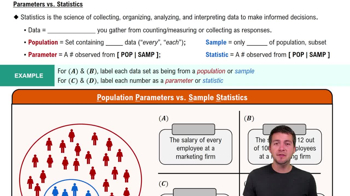
Parameters vs. Statistics