
Ch. 7 - Hypothesis Testing with One Sample
Larson - Elementary Statistics: Picturing the World 8th Edition
Larson8th EditionElementary Statistics: Picturing the WorldISBN: 9780137493470Non è quello che usi tu?Cambia libro di testo
Capitolo 7, Problema 7.RE.9c

In Exercises 7–10, explain whether the hypothesis test is left-tailed, right-tailed, or two-tailed. A nonprofit consumer organization says that the standard deviation of the starting prices of its top-rated vehicles for a recent year is no more than \$2900.

Guida verificata passo dopo passo
1
Step 1: Understand the hypothesis test setup. The null hypothesis (H₀) states that the standard deviation of the starting prices of the top-rated vehicles is no more than \$2900. This can be written as H₀: σ ≤ 2900, where σ represents the population standard deviation.
Step 2: Identify the alternative hypothesis (H₁). The alternative hypothesis challenges the null hypothesis and states that the standard deviation is greater than \$2900. This can be written as H₁: σ > 2900.
Step 3: Determine the direction of the test based on the alternative hypothesis. Since the alternative hypothesis (H₁) specifies that the standard deviation is greater than \$2900, this indicates a right-tailed test.
Step 4: Recall the definition of a right-tailed test. A right-tailed test is used when the alternative hypothesis suggests that the parameter of interest is greater than the value stated in the null hypothesis.
Step 5: Conclude that the hypothesis test is right-tailed because the alternative hypothesis focuses on values of the standard deviation that are greater than \$2900.

Risposta video verificata per un problema simile:

Questa soluzione video è stata consigliata dai nostri tutor come utile per risolvere questo problema.
Durata del video:
3m

Concetti chiave

Ecco i concetti essenziali che devi comprendere per rispondere correttamente alla domanda.

Hypothesis Testing

Hypothesis testing is a statistical method used to make decisions about a population based on sample data. It involves formulating a null hypothesis (H0) and an alternative hypothesis (H1), then using sample data to determine whether to reject H0. The outcome helps in assessing whether there is enough evidence to support a specific claim about a population parameter.
Video consigliato:
Percorso guidato
06:21
Step 1: Write Hypotheses

One-Tailed vs. Two-Tailed Tests

In hypothesis testing, a one-tailed test evaluates the direction of an effect, either testing if a parameter is greater than or less than a certain value. A two-tailed test, on the other hand, assesses whether a parameter is significantly different from a specified value in either direction. The choice between these tests depends on the research question and the nature of the hypothesis.
Video consigliato:
Percorso guidato
09:27
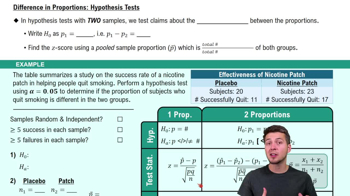
Difference in Proportions: Hypothesis Tests

Standard Deviation and Population Parameters

Standard deviation is a measure of the amount of variation or dispersion in a set of values. In the context of hypothesis testing, it is often used to describe the variability of a population parameter. When a claim is made about the standard deviation, such as it being 'no more than' a certain value, it sets the stage for testing whether the actual standard deviation exceeds this threshold, influencing the type of test used.
Video consigliato:
Percorso guidato
08:45
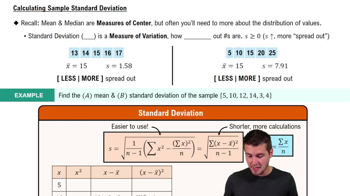
Calculating Standard Deviation