Ch. 7 - Hypothesis Testing with One Sample
Larson - Elementary Statistics: Picturing the World 8th Edition
Larson8th EditionElementary Statistics: Picturing the WorldISBN: 9780137493470Non è quello che usi tu?Cambia libro di testo
Capitolo 7, Problema 7.2.46

Writing In a right-tailed test where P < alpha, does the standardized test statistic lie to the left or the right of the critical value? Explain your reasoning.

Guida verificata passo dopo passo
1
Understand the context of the problem: A right-tailed test is a hypothesis test where the rejection region is located in the right tail of the distribution. This means we are testing whether the test statistic is significantly greater than the critical value.
Recall the relationship between P-value and alpha: If P < alpha, it indicates that the observed data is statistically significant, and we reject the null hypothesis.
Understand the role of the critical value: The critical value is the threshold that separates the rejection region (right tail) from the non-rejection region. In a right-tailed test, any test statistic greater than the critical value falls in the rejection region.
Analyze the placement of the standardized test statistic: Since P < alpha, the test statistic must fall in the rejection region. In a right-tailed test, this means the test statistic lies to the right of the critical value.
Summarize the reasoning: The standardized test statistic lies to the right of the critical value because the P-value being less than alpha indicates that the test statistic is in the rejection region, which is located in the right tail of the distribution.

Risposta video verificata per un problema simile:

Questa soluzione video è stata consigliata dai nostri tutor come utile per risolvere questo problema.
Durata del video:
2m

Concetti chiave

Ecco i concetti essenziali che devi comprendere per rispondere correttamente alla domanda.

Right-tailed Test

A right-tailed test is a type of hypothesis test where the critical region for rejecting the null hypothesis is located in the right tail of the distribution. This means that we are looking for evidence that the sample statistic is significantly greater than the hypothesized parameter. In this context, if the p-value is less than the significance level (alpha), it indicates strong evidence against the null hypothesis.
Video consigliato:
Percorso guidato
06:34
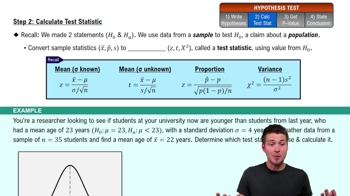
Step 2: Calculate Test Statistic

Critical Value

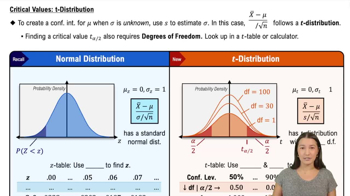
The critical value is a threshold that determines the boundary for rejecting the null hypothesis in a statistical test. In a right-tailed test, the critical value is located at the alpha level on the right side of the distribution. If the standardized test statistic exceeds this critical value, it suggests that the observed data is statistically significant, leading to the rejection of the null hypothesis.
Video consigliato:
Percorso guidato
05:50
Critical Values: t-Distribution

Standardized Test Statistic

The standardized test statistic is a value that indicates how many standard deviations an observed value is from the mean under the null hypothesis. In a right-tailed test, if the standardized test statistic is greater than the critical value, it suggests that the observed data is significantly higher than expected. Therefore, when P < alpha, the standardized test statistic lies to the right of the critical value, indicating statistical significance.
Video consigliato:
Percorso guidato
06:34
Step 2: Calculate Test Statistic
Pratica correlata
Domanda del libro di testo

Explain the difference between the z-test for μ using a P-value and the z-test for μ using rejection region(s).

109
views

Domanda del libro di testo

Does failing to reject the null hypothesis mean that the null hypothesis is true? Explain.

397
views
Domanda del libro di testo

Explain how to use a t-test to test a hypothesized mean mu when sigma is unknown. What assumptions are necessary?

125
views
Domanda del libro di testo

In Exercises 3–8, find the critical value(s) and rejection region(s) for the type of t-test with level of significance alpha and sample size n.


Right-tailed test, α=0.01, n=31

97
views
Domanda del libro di testo

Dive Duration An oceanographer claims that the mean dive duration of a North Atlantic right whale is 11.5 minutes. A random sample of 34 dive durations has a mean of 12.2 minutes and a standard deviation of 2.2 minutes. Is there enough evidence to reject the claim at α=0.10?

65
views
Domanda del libro di testo

Hypothesis Testing Using Rejection Regions In Exercises 7–12, (a) identify the claim and state H0 and Ha, (b) find the critical value(s) and identify the rejection region(s), (c) find the standardized test statistic z, (d) decide whether to reject or fail to reject the null hypothesis, and (e) interpret the decision in the context of the original claim.


Working Students An education researcher claims that 65% of full-time college students work year-round. In a random sample of 105 college students, 66 say they work year-round. At α=0.10, is there enough evidence to reject the researcher’s claim?

130
views