
Ch. 1 - Introduction to Statistics
Triola - Elementary Statistics 14th Edition
Triola14th EditionElementary StatisticsISBN: 9780137366446Non è quello che usi tu?Cambia libro di testo
Capitolo 1, Problema 1.2.4.c

E-Cigarette Survey In a survey of 36,000 adults, 3.7% said that they regularly use E-cigarettes (based on data from the National Center for Health Statistics)


c. What is the level of measurement of the value of 3.7%? (nominal, ordinal, interval, ratio)

Guida verificata passo dopo passo
1
Understand the four levels of measurement: nominal, ordinal, interval, and ratio. Nominal involves categories without a specific order, ordinal involves categories with a specific order, interval involves numerical values with meaningful differences but no true zero, and ratio involves numerical values with meaningful differences and a true zero.
Identify the type of data represented by the percentage 3.7%. This percentage represents a proportion of the surveyed population that regularly uses E-cigarettes.
Consider whether the percentage 3.7% can be categorized, ordered, or measured with meaningful differences and a true zero point.
Recognize that percentages are numerical values that can be compared with meaningful differences and have a true zero point (0% means none of the population uses E-cigarettes).
Conclude that the level of measurement for the value 3.7% is 'ratio' because it is a numerical value with a true zero point and meaningful differences.

Risposta video verificata per un problema simile:

Questa soluzione video è stata consigliata dai nostri tutor come utile per risolvere questo problema.
Durata del video:
3m

Concetti chiave

Ecco i concetti essenziali che devi comprendere per rispondere correttamente alla domanda.

Levels of Measurement

Levels of measurement refer to the different ways in which variables can be categorized and quantified. There are four primary levels: nominal, ordinal, interval, and ratio. Each level has distinct characteristics that determine how data can be analyzed and interpreted. Understanding these levels is crucial for selecting appropriate statistical methods and accurately interpreting results.
Video consigliato:
Percorso guidato
04:46
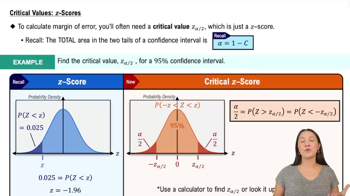
Critical Values: z Scores

Ratio Level of Measurement

The ratio level of measurement is the highest level of measurement, characterized by the presence of a true zero point and the ability to perform meaningful mathematical operations. In this level, both differences and ratios between values are meaningful. For example, a percentage like 3.7% can be interpreted in terms of proportions, making it a ratio measurement since it can be compared to zero (indicating no usage).
Video consigliato:
Percorso guidato
04:46
Critical Values: z Scores

Percentage as a Measurement

A percentage is a way of expressing a number as a fraction of 100, which allows for easy comparison across different groups or categories. In the context of survey data, percentages help quantify the prevalence of a characteristic, such as E-cigarette usage. Understanding how to interpret percentages is essential for analyzing survey results and making informed conclusions about the population being studied.
Video consigliato:
Percorso guidato
04:39
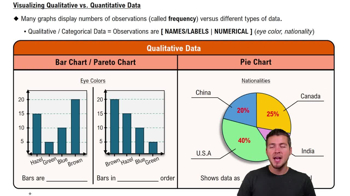
Visualizing Qualitative vs. Quantitative Data