Ch. 1 - Introduction to Statistics
Triola - Elementary Statistics 14th Edition
Triola14th EditionElementary StatisticsISBN: 9780137366446Non è quello che usi tu?Cambia libro di testo
Capitolo 1, Problema 1.CRE.12

In Exercises 9–12, the given expressions are designed to yield results expressed in a form of scientific notation. For example, the calculator-displayed result of 1.23E5 can be expressed as 123,000, and the result of 1.23E-4 can be expressed as 0.000123. Perform the indicated operation and express the result as an ordinary number that is not in scientific notation.


(0.2)^12

Guida verificata passo dopo passo
1
Understand the problem: You need to calculate the value of (0.2)^12 and express the result as an ordinary number, not in scientific notation.
Recognize that (0.2)^12 involves exponentiation, where 0.2 is the base and 12 is the exponent. This means you multiply 0.2 by itself 12 times.
Use a calculator to perform the operation: Enter 0.2 and use the exponentiation function to raise it to the power of 12.
Once you have the result from the calculator, check if it is displayed in scientific notation. If it is, convert it to an ordinary number by moving the decimal point according to the exponent.
Write down the final result as an ordinary number, ensuring that it is not in scientific notation, and verify the accuracy of your conversion.

Risposta video verificata per un problema simile:

Questa soluzione video è stata consigliata dai nostri tutor come utile per risolvere questo problema.
Durata del video:
3m

Concetti chiave

Ecco i concetti essenziali che devi comprendere per rispondere correttamente alla domanda.

Scientific Notation

Scientific notation is a way of expressing numbers that are too large or too small to be conveniently written in decimal form. It is typically used in scientific and engineering contexts. A number is expressed in the form of a × 10^n, where 1 ≤ a < 10 and n is an integer. For example, 1.23E5 represents 123,000.
Video consigliato:
Percorso guidato
08:24
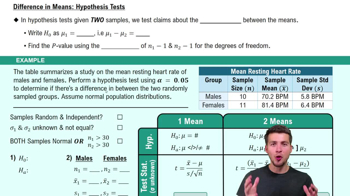
Difference in Means: Hypothesis Tests

Exponentiation

Exponentiation is a mathematical operation involving two numbers, the base and the exponent. The operation is written as b^n, where b is the base and n is the exponent, meaning b is multiplied by itself n times. For example, (0.2)^12 means multiplying 0.2 by itself 12 times, which is crucial for solving the given expression.

Converting Scientific Notation to Decimal

Converting scientific notation to a decimal involves moving the decimal point to the right for positive exponents or to the left for negative exponents, based on the power of ten. For instance, 1.23E-4 is converted to 0.000123 by moving the decimal point four places to the left, which is essential for expressing results in ordinary numbers.
Video consigliato:
Percorso guidato
08:24
Difference in Means: Hypothesis Tests
Pratica correlata
Domanda del libro di testo

Physicians’ Health Study In the Physicians’ Health Study, some of the subjects were treated with aspirin while others were given a placebo. For the subjects in this experiment, what is blinding?

272
views

Domanda del libro di testo

Survey Which of the following best describes the level of measurement of the numbers 1, 2, 3, . . . , 410 described in Exercise 1: nominal, ordinal, interval, ratio?

344
views
Domanda del libro di testo

Percentages

c. In a Pew Research Center poll on driving, 331 of the 1182 respondents said that driving is a chore. What percentage of respondents said that driving is a chore?

251
views
Domanda del libro di testo

In Exercises 9–12, the given expressions are designed to yield results expressed in a form of scientific notation. For example, the calculator-displayed result of 1.23E5 can be expressed as 123,000, and the result of 1.23E-4 can be expressed as 0.000123. Perform the indicated operation and express the result as an ordinary number that is not in scientific notation.


(8)^12

252
views
Domanda del libro di testo

Birth Weights For 100 randomly selected births from Bellevue Hospital Center, the birth weights are added and then divided by 100. The result is 3240 g. Is the value of 3240 g a statistic or a parameter?

294
views
Domanda del libro di testo

Types of Data In each of the following, identify the level of measurement of the sample data (nominal, ordinal, interval, ratio) and the type of sampling used to obtain the data (random, systematic, convenience, stratified, cluster).


b. In each of the 50 states, 50 voters are randomly selected and their political party affiliations are identified.

280
views