
Ch. 1 - Introduction to Statistics
Triola - Elementary Statistics 14th Edition
Triola14th EditionElementary StatisticsISBN: 9780137366446Non è quello che usi tu?Cambia libro di testo
Capitolo 1, Problema 1.3.12

In Exercises 9–20, identify which of these types of sampling is used: random, systematic, convenience, stratified, or cluster.
Reported and Observed Results A Harris Interactive study involved 1013 adults who were interviewed about washing their hands in restrooms and another 6336 adults who were observed in public restrooms.

Guida verificata passo dopo passo
1
Understand the different types of sampling methods: random, systematic, convenience, stratified, and cluster.
Random sampling involves selecting individuals from a population in such a way that each individual has an equal chance of being chosen.
Systematic sampling involves selecting every nth individual from a list or sequence.
Convenience sampling involves selecting individuals who are easiest to reach or sample.
Stratified sampling involves dividing the population into subgroups (strata) and then taking a sample from each subgroup.

Risposta video verificata per un problema simile:

Questa soluzione video è stata consigliata dai nostri tutor come utile per risolvere questo problema.
Durata del video:
5m

Concetti chiave

Ecco i concetti essenziali che devi comprendere per rispondere correttamente alla domanda.

Types of Sampling

Sampling is a method used to select a subset of individuals from a population to estimate characteristics of the whole population. The main types include random sampling, where every individual has an equal chance of being selected; systematic sampling, which involves selecting every nth individual; convenience sampling, based on ease of access; stratified sampling, which divides the population into subgroups; and cluster sampling, where entire groups are randomly selected.
Video consigliato:
Percorso guidato
05:11
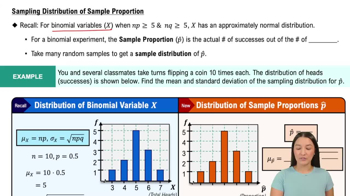
Sampling Distribution of Sample Proportion

Random Sampling

Random sampling is a technique where each member of the population has an equal probability of being chosen. This method helps to eliminate bias and ensures that the sample is representative of the population, which is crucial for the validity of statistical inferences. It is often achieved through methods like lottery or random number generators.
Video consigliato:
Percorso guidato
05:11
Sampling Distribution of Sample Proportion

Observational Study

An observational study is a research method where the researcher observes and records behavior without manipulating any variables. In the context of the question, the study involved observing adults in public restrooms to gather data on handwashing habits. This type of study can provide valuable insights but does not establish cause-and-effect relationships.
Video consigliato:
Percorso guidato
04:39
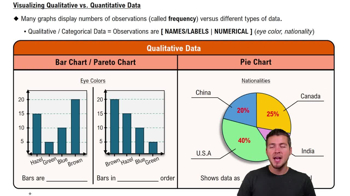
Visualizing Qualitative vs. Quantitative Data
Pratica correlata
Domanda del libro di testo

In Exercises 29–32, identify the level of measurement of the data as nominal, ordinal, interval, or ratio. Also, explain what is wrong with the given calculation.

Social Security Numbers As part of a project in a statistics class, students report the last four digits of their Social Security numbers, and the average (mean) of those digits is computed to be 4.7.

424
views
Domanda del libro di testo

In Exercises 9–12, determine whether the sampling method appears to be sound or is flawed.


Clinical Trials Researchers at Yale University conduct a wide variety of clinical trials by using subjects who volunteer after reading advertisements soliciting paid volunteers.

297
views
Domanda del libro di testo

In Exercises 13–20, determine whether the results appear to have statistical significance, and also determine whether the results appear to have practical significance.


Mendel’s Genetics Experiments One of Gregor Mendel’s famous hybridization experiments with peas yielded 580 offspring with 152 of those peas (or 26%) having yellow pods. According to Mendel’s theory, 25% of the offspring peas should have yellow pods.

356
views
Domanda del libro di testo

In Exercises 37–44, answer the given questions, which are related to percentages.

Checking Job Applicants In a study conducted by the Society for Human Resource Management, 347 human resource professionals were surveyed. Of those surveyed, 73% said that their companies conduct criminal background checks on all job applicants.


a. What is the exact value that is 73% of the 347 survey subjects?

b. Could the result from part (a) be the actual number of survey subjects who said that their companies conduct criminal background checks on all job applicants? Why or why not?

390
views
Domanda del libro di testo

Quantitative/Categorical Data Identify each of the following as quantitative data or categorical data


c. The colors of the M&M candies in Data Set 38 “Candies” in Appendix B

209
views
Domanda del libro di testo

Sampling Method The patients were recruited among those at a Veterans Affairs hospital. What type of sampling best describes the way in which the subjects were chosen: simple random sample, systematic sample, convenience sample, stratified sample, cluster sample? Does the method of sampling appear to adversely affect the quality of the results?

282
views