

Ch. 3 - Describing, Exploring, and Comparing Data
Triola - Elementary Statistics 14th Edition
Triola14th EditionElementary StatisticsISBN: 9780137366446Non è quello che usi tu?Cambia libro di testo
Capitolo 3, Problema 3.3.5c

z Scores. In Exercises 5–8, express all z scores with two decimal places.


Diastolic Blood Pressure of Females For the diastolic blood pressure measurements of females listed in Data Set 1 “Body Data” in Appendix B, the highest measurement is 98 mm Hg. The 147 diastolic blood pressure measurements of females have a mean of 70.2 mm Hg and a standard deviation of 11.2 mm Hg.


c. Convert the highest diastolic blood pressure to a z score.

Guida verificata passo dopo passo
1
Step 1: Recall the formula for calculating a z-score: z=X-μσ, where X is the data value, μ is the mean, and σ is the standard deviation.
Step 2: Identify the values given in the problem: X (highest diastolic blood pressure) = 98 mm Hg, μ (mean) = 70.2 mm Hg, and σ (standard deviation) = 11.2 mm Hg.
Step 3: Substitute the values into the z-score formula: z=98-70.211.2.
Step 4: Perform the subtraction in the numerator: 98-70.2.
Step 5: Divide the result of the subtraction by the standard deviation 11.2 to find the z-score, rounding to two decimal places.

Risposta video verificata per un problema simile:

Questa soluzione video è stata consigliata dai nostri tutor come utile per risolvere questo problema.
Durata del video:
1m

Concetti chiave

Ecco i concetti essenziali che devi comprendere per rispondere correttamente alla domanda.

Z Score

A z score, or standard score, indicates how many standard deviations an element is from the mean of a data set. It is calculated using the formula: z = (X - μ) / σ, where X is the value, μ is the mean, and σ is the standard deviation. Z scores are useful for comparing values from different distributions and understanding their relative position within a distribution.
Video consigliato:
Percorso guidato
06:31
Z-Scores From Given Probability - TI-84 (CE) Calculator

Mean

The mean, or average, is a measure of central tendency that summarizes a set of values by dividing the sum of all values by the number of values. In the context of the diastolic blood pressure measurements, the mean provides a reference point to understand the typical blood pressure level among the sampled females. It is essential for calculating z scores, as it represents the baseline from which deviations are measured.
Video consigliato:
Percorso guidato
04:52
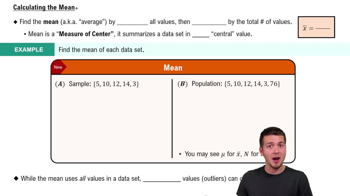
Calculating the Mean

Standard Deviation

Standard deviation is a statistic that quantifies the amount of variation or dispersion in a set of values. A low standard deviation indicates that the values tend to be close to the mean, while a high standard deviation indicates a wider spread. In this exercise, the standard deviation of 11.2 mm Hg helps to understand how individual diastolic blood pressure measurements vary from the mean, which is crucial for calculating z scores.
Video consigliato:
Percorso guidato
08:45
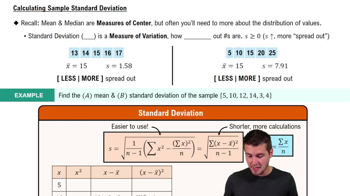
Calculating Standard Deviation
Pratica correlata
Domanda del libro di testo

Why Divide by ? Let a population consist of the values 9 cigarettes, 10 cigarettes, and 20 cigarettes smoked in a day (based on data from the California Health Interview Survey). Assume that samples of two values are randomly selected with replacement from this population. (That is, a selected value is replaced before the second selection is made.)


c. For each of the nine different possible samples of two values selected with replacement, find the variance by treating each sample as if it is a population (using the formula for population variance, which includes division by n); then find the mean of those nine population variances.

133
views
Domanda del libro di testo

z Scores. In Exercises 5–8, express all z scores with two decimal places.


New York City Commute Time New York City commute times (minutes) are listed in Data Set 31 “Commute Times” in Appendix B. The 1000 times have a mean of 42.6 minutes and a standard deviation of 26.2 minutes. Consider the commute time of 95.0 minutes.


c. Convert the commute time of 95.0 minutes to a z score.

127
views
Domanda del libro di testo

Why Divide by ? Let a population consist of the values 9 cigarettes, 10 cigarettes, and 20 cigarettes smoked in a day (based on data from the California Health Interview Survey). Assume that samples of two values are randomly selected with replacement from this population. (That is, a selected value is replaced before the second selection is made.)


d. Which approach results in values that are better estimates of part (b) or part (c)? Why? When computing variances of samples, should you use division by n or

158
views
Domanda del libro di testo

z Scores. In Exercises 5–8, express all z scores with two decimal places.


Diastolic Blood Pressure of Females For the diastolic blood pressure measurements of females listed in Data Set 1 “Body Data” in Appendix B, the highest measurement is 98 mm Hg. The 147 diastolic blood pressure measurements of females have a mean of 70.2 mm Hg and a standard deviation of 11.2 mm Hg.


b. How many standard deviations is that [the difference found in part (a)]?

122
views
Domanda del libro di testo

Percentile Use the weights from Exercise 1 to find the percentile for 3647 mg.

169
views
Domanda del libro di testo

Why Divide by ? Let a population consist of the values 9 cigarettes, 10 cigarettes, and 20 cigarettes smoked in a day (based on data from the California Health Interview Survey). Assume that samples of two values are randomly selected with replacement from this population. (That is, a selected value is replaced before the second selection is made.)

b. After listing the nine different possible samples of two values selected with replacement, find the sample variance (which includes division by ) for each of them; then find the mean of the nine sample variances s2.

155
views