Ch. 4 - Probability
Triola - Elementary Statistics 14th Edition
Triola14th EditionElementary StatisticsISBN: 9780137366446Non è quello che usi tu?Cambia libro di testo
Capitolo 4, Problema 4.1.1

California Lottery Let A denote the event of placing a \$1 straight bet on the California Daily 4 lottery and winning. There are 10,000 different ways that you can select the four digits (with repetition allowed) in this lottery, and only one of those four-digit numbers will be the winner. What is the value of P(A)? What is the value of P(Abar)?

Guida verificata passo dopo passo
1
Step 1: Understand the problem. The event A represents winning the California Daily 4 lottery with a \$1 straight bet. There are 10,000 possible four-digit combinations (0000 to 9999), and only one of these combinations is the winning number. The probability of event A, P(A), is the ratio of favorable outcomes (1 winning number) to the total possible outcomes (10,000 combinations).
Step 2: Write the formula for P(A). The probability of an event is calculated as P(A) = (Number of favorable outcomes) / (Total number of outcomes). In this case, P(A) = 1 / 10,000.
Step 3: Define the complement of event A, denoted as Ā. The complement of A represents the event of not winning the lottery. The probability of the complement, P(Ā), is related to P(A) by the formula P(Ā) = 1 - P(A).
Step 4: Substitute the value of P(A) into the formula for P(Ā). Using the relationship P(Ā) = 1 - P(A), substitute P(A) = 1 / 10,000 to calculate P(Ā).
Step 5: Conclude that P(A) represents the probability of winning, and P(Ā) represents the probability of not winning. These probabilities should sum to 1, as they are complementary events.

Risposta video verificata per un problema simile:

Questa soluzione video è stata consigliata dai nostri tutor come utile per risolvere questo problema.
Durata del video:
2m

Concetti chiave

Ecco i concetti essenziali che devi comprendere per rispondere correttamente alla domanda.

Probability

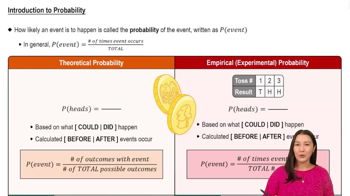
Probability is a measure of the likelihood that a particular event will occur, expressed as a number between 0 and 1. In this context, it quantifies the chance of winning the lottery by placing a specific bet. The probability of an event A, denoted as P(A), is calculated by dividing the number of favorable outcomes by the total number of possible outcomes.
Video consigliato:
Percorso guidato
5:37
Introduction to Probability

Complement of an Event

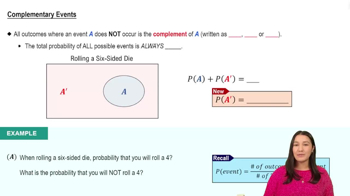
The complement of an event A, denoted as A̅ (A bar), represents all outcomes in which event A does not occur. In the lottery scenario, P(A̅) would be the probability of not winning the lottery after placing a bet. The relationship between an event and its complement is given by P(A) + P(A̅) = 1, which helps in calculating probabilities when one is known.
Video consigliato:
Percorso guidato
4:23
Complementary Events

Counting Principles

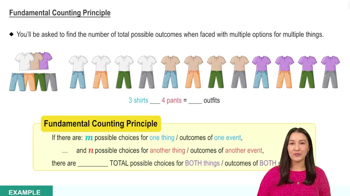
Counting principles, such as the fundamental counting principle, are used to determine the total number of possible outcomes in a scenario. In the California Daily 4 lottery, there are 10,000 possible combinations of four digits (with repetition allowed), which is crucial for calculating the probabilities of winning and losing. Understanding how to count these outcomes accurately is essential for probability calculations.
Video consigliato:
Percorso guidato
04:04
Fundamental Counting Principle
Pratica correlata
Domanda del libro di testo

Shared Birthdays Find the probability that of 25 randomly selected people, at least 2 share the same birthday.

187
views

Domanda del libro di testo

Unseen Coins A statistics professor tosses two coins that cannot be seen by any students. One student asks this question: “Did one of the coins turn up heads?” Given that the professor’s response is “yes,” find the probability that both coins turned up heads.

130
views
Domanda del libro di testo

Notation What does the symbol ! represent? The five starting players of an NBA basketball team can stand in a line 5! different ways, so what is the actual number of ways that the five players can stand in a line?

231
views
Domanda del libro di testo

In Exercises 21-28, find the probability and answer the questions.


YSORT Gender Selection MicroSort’s YSORT gender selection technique is designed to increase the likelihood that a baby will be a boy. At one point before clinical trials of the YSORT gender selection technique were discontinued, 291 births consisted of 239 baby boys and 52 baby girls (based on data from the Genetics & IVF Institute). Based on these results, what is the probability of a boy born to a couple using MicroSort’s YSORT method? Does it appear that the technique is effective in increasing the likelihood that a baby will be a boy?

181
views
Domanda del libro di testo

Laundry Symbols Based on a New Generation of Stains survey, 13% of U.S. adults know that the care-instruction symbol on clothing means that any bleach can be used. Find the probability of randomly selecting an adult in the U.S. who does not know that.

158
views
Domanda del libro di testo

Jumble Many newspapers carry “Jumble,” a puzzle in which the reader must unscramble letters to form words. The letters MHRHTY were included in newspapers on the day this exercise was written. How many ways can those letters be arranged? Identify the correct unscrambling, then determine the probability of getting that result by randomly selecting one arrangement of the given letters.

207
views