Skip to main content
Trigonometry
Il mio corso
Impara
Preparazione agli esami
AI Tutor
Guide di studio
Soluzioni per libri di testo
Flashcard
Esplora
Prova l'app
Il mio corso
Impara
Preparazione agli esami
AI Tutor
Guide di studio
Soluzioni per libri di testo
Flashcard
Esplora
Prova l'app
Indietro
Cross Product quiz
Puoi toccare per girare la carta.
What is the result of the cross product of two vectors?
Puoi toccare per girare la carta.
👆
What is the result of the cross product of two vectors?
The cross product of two vectors results in a vector that is perpendicular to both original vectors.
Avanzamenti del tracciato
I pulsanti di controllo sono stati cambiati in modalità "navigazione".
1/15
Flashcard correlate
Pratica correlata
Video consigliati
Cross Product definitions
Cross Product
15 Termini
Cross Product
8. Vectors
3 Problemi
Argomento
Dot Product
8. Vectors
6 Problemi
Argomento
Patrick
8. Vectors
5 Argomenti
11 Problemi
Capitolo
Patrick
VideoThumbView.guidedCourse
05:21
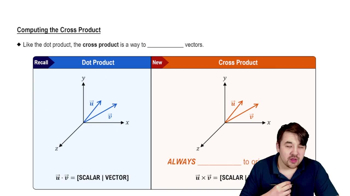
Computing the Cross Product
544
views
4
rank
Termini in questo insieme (15)
Nascondere definizioni
What is the result of the cross product of two vectors?
The cross product of two vectors results in a vector that is perpendicular to both original vectors.
How does the cross product differ from the dot product?
The cross product produces a vector, while the dot product produces a scalar.
What is the first step in calculating the cross product of two vectors?
The first step is to write a matrix with the i, j, k unit vectors on the top row, followed by the components of the two vectors.
Why do you repeat the i and j columns outside the matrix when calculating the cross product?
Repeating the i and j columns helps facilitate the cross product calculation using the cross down and up strategy.
What pattern is used to calculate each component of the cross product?
Each component is calculated by multiplying unlike components and subtracting the results (uv - vu).
What is the cross down and up strategy in the cross product calculation?
It involves multiplying components diagonally down and then up in the matrix to find each vector component.
What are the components of the cross product for vectors u = (2, 0, 1) and v = (0, -1, 2)?
The cross product components are (1, -4, -2).
How is the x component of the cross product calculated in the example?
The x component is calculated as 0 × 2 minus (-1) × 1, which equals 1.
How is the y component of the cross product calculated in the example?
The y component is 1 × 0 minus 2 × 2, which equals -4.
How is the z component of the cross product calculated in the example?
The z component is 2 × (-1) minus 0 × 0, which equals -2.
What is the final vector result of the cross product in unit vector form?
The result is 1i - 4j - 2k.
What is the final vector result of the cross product in component form?
The result is (1, -4, -2).
What is always true about the direction of the cross product vector relative to the original vectors?
The cross product vector is always perpendicular to the original vectors.
What operation is performed for each component in the cross product calculation?
For each component, you multiply unlike components and subtract the results.
Why is the cross product process considered tedious, and how can it be simplified?
It is tedious due to multiple steps, but recognizing the pattern of multiplying unlike components and subtracting helps simplify the calculation.
 IndietroIndietro
 05:21
05:21