Skip to main content
Trigonometry
Il mio corso
Impara
Preparazione agli esami
AI Tutor
Guide di studio
Soluzioni per libri di testo
Flashcard
Esplora
Prova l'app
Il mio corso
Impara
Preparazione agli esami
AI Tutor
Guide di studio
Soluzioni per libri di testo
Flashcard
Esplora
Prova l'app
Indietro
Products and Quotients of Complex Numbers quiz
Puoi toccare per girare la carta.
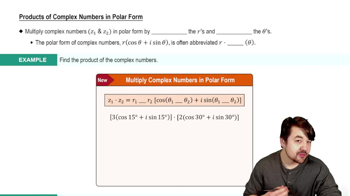
How do you multiply two complex numbers in polar form?
Puoi toccare per girare la carta.
👆
How do you multiply two complex numbers in polar form?
Multiply their r values and add their angles.
Avanzamenti del tracciato
I pulsanti di controllo sono stati cambiati in modalità "navigazione".
1/15
Flashcard correlate
Pratica correlata
Video consigliati
Products and Quotients of Complex Numbers definitions
Products and Quotients of Complex Numbers
15 Termini
Products and Quotients of Complex Numbers
11. Graphing Complex Numbers
2 Problemi
Argomento
Patrick
Powers of Complex Numbers (DeMoivre's Theorem)
11. Graphing Complex Numbers
4 Problemi
Argomento
Patrick
11. Graphing Complex Numbers
4 Argomenti
8 Problemi
Capitolo
Patrick
VideoThumbView.guidedCourse
03:40
Quotients of Complex Numbers in Polar Form
559
views
2
rank
VideoThumbView.guidedCourse
04:46
Products of Complex Numbers in Polar Form
559
views
3
rank
Termini in questo insieme (15)
Nascondere definizioni
How do you multiply two complex numbers in polar form?
Multiply their r values and add their angles.
What is the shortcut notation for writing a complex number in polar form?
The shortcut is 'cis', so r cis θ stands for r(cos θ + i sin θ).
When multiplying complex numbers in polar form, what do you do with the angles?
You add the angles together.
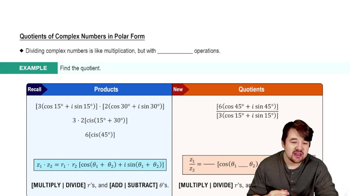
How do you divide two complex numbers in polar form?
Divide their r values and subtract their angles.
What does 'cis θ' represent in polar form?
'cis θ' stands for cos θ plus i times sin θ.
If you multiply 3 cis 15° and 2 cis 30°, what is the result?
The result is 6 cis 45°.
If you divide 6 cis 45° by 3 cis 15°, what is the result?
The result is 2 cis 30°.
What operation do you perform on the r values when dividing complex numbers in polar form?
You divide the r values.
What operation do you perform on the angles when dividing complex numbers in polar form?
You subtract the angles.
How would you write 4(cos(π/6) + i sin(π/6)) in shortcut notation?
You would write it as 4 cis π/6.
What is the product of 4 cis (π/6) and 5 cis (π/3)?
The product is 20 cis (π/2).
What is the quotient of 5 cis (π/3) divided by 4 cis (π/9)?
The quotient is (5/4) cis (2π/9).
Why is using 'cis' notation helpful when working with complex numbers in polar form?
It makes writing and simplifying expressions quicker and less tedious.
What is the general formula for multiplying two complex numbers in polar form?
The formula is r₁ cis θ₁ times r₂ cis θ₂ equals (r₁r₂) cis (θ₁ + θ₂).
What is the general formula for dividing two complex numbers in polar form?
The formula is r₁ cis θ₁ divided by r₂ cis θ₂ equals (r₁/r₂) cis (θ₁ - θ₂).
 IndietroIndietro
 03:40
03:40