Skip to main content
Trigonometry
Il mio corso
Impara
Preparazione agli esami
AI Tutor
Guide di studio
Soluzioni per libri di testo
Flashcard
Esplora
Prova l'app
Il mio corso
Impara
Preparazione agli esami
AI Tutor
Guide di studio
Soluzioni per libri di testo
Flashcard
Esplora
Prova l'app
Indietro
Trigonometry: Angles and Their Properties
Puoi toccare per girare la carta.
What is an angle in standard position?
Puoi toccare per girare la carta.
👆
What is an angle in standard position?
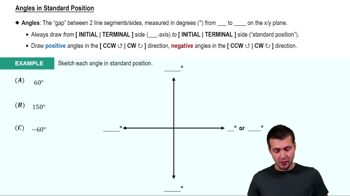
An angle with its vertex at the origin, initial side on the positive x-axis, and terminal side rotated from the initial side.
Avanzamenti del tracciato
I pulsanti di controllo sono stati cambiati in modalità "navigazione".
1/20
Video consigliati
VideoThumbView.guidedCourse
3:59
Example 1
1606
views
32
rank
VideoThumbView.guidedCourse
05:50
Drawing Angles in Standard Position
2685
views
75
rank
Termini in questo insieme (20)
Nascondere definizioni
What is an angle in standard position?
An angle with its vertex at the origin, initial side on the positive x-axis, and terminal side rotated from the initial side.
How is the measure of an angle in standard position determined?
By the amount of rotation from the initial side to the terminal side, measured in degrees or radians.
What are the four types of angles based on their measure?
Acute
(less than 90°),
Right
(exactly 90°),
Obtuse
(between 90° and 180°), and
Straight
(exactly 180°).
Define complementary angles.
Two angles whose measures add up to \(90^\circ\).
Define supplementary angles.
Two angles whose measures add up to \(180^\circ\).
What is the complement of a 30° angle?
60°, because 30° + 60° = 90°.
What is the supplement of a 110° angle?
70°, because 110° + 70° = 180°.
How do you find the complement of an angle \(x\)?
Subtract the angle from 90°, i.e., \(90^\circ - x\).
How do you find the supplement of an angle \(x\)?
Subtract the angle from 180°, i.e., \(180^\circ - x\).
What is the sum of the interior angles of a triangle?
Always \(180^\circ\).
How can complementary and supplementary angles help solve triangle problems?
They help find unknown angles by using the relationships that angles add up to 90° or 180°.
What is a radian?
A radian is a measure of angle based on the radius of a circle; one radian is the angle subtended by an arc equal in length to the radius.
How many radians are in a full circle?
A full circle is \(2\pi\) radians.
How many degrees are in a full circle?
A full circle is 360 degrees.
What is the formula to convert degrees to radians?
Multiply degrees by \(\frac{\pi}{180}\\).
What is the formula to convert radians to degrees?
Multiply radians by \(\frac{180}{\pi}\\).
Convert 120° to radians.
120° × \(\frac{\pi}{180}\\) = \(\frac{2\pi}{3}\\) radians.
Convert \(\frac{\pi}{5}\\) radians to degrees.
\(\frac{\pi}{5}\\) × \(\frac{180}{\pi}\\) = 36°.
What is the relationship between the initial side and terminal side in an angle in standard position?
The initial side lies on the positive x-axis; the terminal side is the rotated ray that forms the angle.
What is the difference between acute and obtuse angles?
Acute angles measure less than 90°, while obtuse angles measure more than 90° but less than 180°.
 IndietroIndietro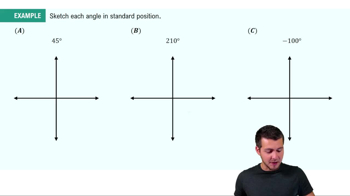
 3:59
3:59