Ch. 1 - Angles and the Trigonometric Functions
Blitzer - Trigonometry 3rd Edition
Blitzer3rd EditionTrigonometryISBN: 9780137316601Non è quello che usi tu?Cambia libro di testo
Capitolo 1, Problema 25

In Exercises 25–32, the unit circle has been divided into eight equal arcs, corresponding to t-values of 0, 𝜋, 𝜋, 3𝜋, 𝜋, 5𝜋, 3𝜋, 7𝜋, and 2𝜋. 4 2 4 4 2 4 a. Use the (x,y) coordinates in the figure to find the value of the trigonometric function. b. Use periodic properties and your answer from part (a) to find the value of the same trigonometric function at the indicated real number. Unit circle with coordinates for angles 0, π/4, π/2, and others marked.
sin 11𝜋/4

Guida verificata passo dopo passo
1
Identify the angle 11\(\pi\)/4 on the unit circle by finding its equivalent angle within the interval [0, 2\(\pi\)).
Calculate 11\(\pi\)/4 modulo 2\(\pi\) to find the equivalent angle: 11\(\pi\)/4 - 2\(\pi\) = 11\(\pi\)/4 - 8\(\pi\)/4 = 3\(\pi\)/4.
Locate the angle 3\(\pi\)/4 on the unit circle, which corresponds to the coordinates \((-\sqrt{2}/2, \sqrt{2}/2)\).
The sine of an angle is the y-coordinate of its corresponding point on the unit circle.
Therefore, \(\sin\)(11\(\pi\)/4) is equal to the y-coordinate of the point at 3\(\pi\)/4, which is \(\sqrt{2}/2\).

Risposta video verificata per un problema simile:

Questa soluzione video è stata consigliata dai nostri tutor come utile per risolvere questo problema.
Durata del video:
5m

Concetti chiave

Ecco i concetti essenziali che devi comprendere per rispondere correttamente alla domanda.

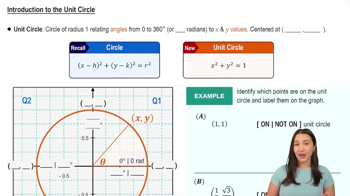
Unit Circle

The unit circle is a circle with a radius of one centered at the origin of a coordinate plane. It is fundamental in trigonometry as it provides a geometric representation of the sine and cosine functions. The coordinates of points on the unit circle correspond to the cosine and sine values of angles measured in radians, allowing for easy calculation of these trigonometric functions.
Video consigliato:
Percorso guidato
06:11
Introduction to the Unit Circle

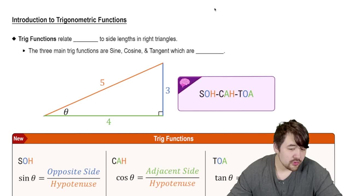
Trigonometric Functions

Trigonometric functions, such as sine and cosine, relate the angles of a triangle to the lengths of its sides. On the unit circle, the sine of an angle is represented by the y-coordinate, while the cosine is represented by the x-coordinate of the corresponding point on the circle. Understanding these functions is crucial for solving problems involving angles and their relationships in various contexts.
Video consigliato:
Percorso guidato
6:04
Introduction to Trigonometric Functions

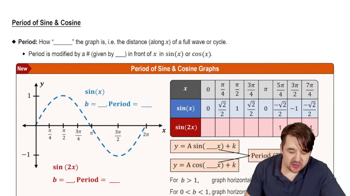
Periodic Properties

Trigonometric functions exhibit periodic properties, meaning they repeat their values in regular intervals. For example, the sine and cosine functions have a period of 2π, indicating that sin(θ) = sin(θ + 2πk) and cos(θ) = cos(θ + 2πk) for any integer k. This property allows for the simplification of calculations involving angles greater than 2π by reducing them to an equivalent angle within the standard range.
Video consigliato:
Percorso guidato
5:33
Period of Sine and Cosine Functions
Pratica correlata