Ch. 1 - Angles and the Trigonometric Functions
Blitzer - Trigonometry 3rd Edition
Blitzer3rd EditionTrigonometryISBN: 9780137316601Non è quello che usi tu?Cambia libro di testo
Capitolo 1, Problema 1.3.52

In Exercises 35–60, find the reference angle for each angle. 553°

Guida verificata passo dopo passo
1
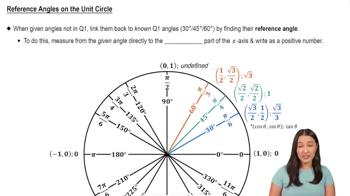
Understand that the reference angle is the acute angle formed between the terminal side of the given angle and the x-axis.
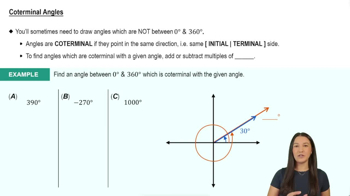
Since the given angle is 553°, which is greater than 360°, first find its coterminal angle by subtracting 360°: calculate \(553° - 360°\).
Determine the quadrant in which the coterminal angle lies by checking its value between 0° and 360°.
Based on the quadrant, use the appropriate formula to find the reference angle: - Quadrant I: reference angle = angle itself - Quadrant II: reference angle = \(180° - \theta\) - Quadrant III: reference angle = \(\theta - 180°\) - Quadrant IV: reference angle = \(360° - \theta\)
Apply the formula corresponding to the quadrant of the coterminal angle to find the reference angle.

Risposta video verificata per un problema simile:

Questa soluzione video è stata consigliata dai nostri tutor come utile per risolvere questo problema.
Durata del video:
3m

Concetti chiave

Ecco i concetti essenziali che devi comprendere per rispondere correttamente alla domanda.

Reference Angle

A reference angle is the acute angle formed between the terminal side of a given angle and the x-axis. It is always between 0° and 90°, and helps simplify trigonometric calculations by relating any angle to a corresponding acute angle.
Video consigliato:
Percorso guidato
5:31
Reference Angles on the Unit Circle

Coterminal Angles

Coterminal angles differ by full rotations of 360°. To find a coterminal angle within a standard range (0° to 360°), add or subtract multiples of 360°. This helps in reducing large angles like 553° to an equivalent angle within one rotation.
Video consigliato:
Percorso guidato
04:46
Coterminal Angles

Quadrants and Angle Position

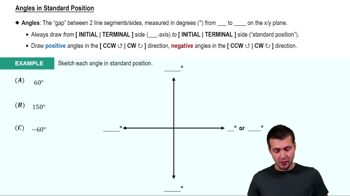
The position of an angle in the coordinate plane (which quadrant it lies in) determines how to calculate its reference angle. Knowing the quadrant helps identify whether to subtract the angle from 180°, 360°, or use the angle directly for the reference angle.
Video consigliato:
Percorso guidato
05:50
Drawing Angles in Standard Position