Ch. 1 - Angles and the Trigonometric Functions
Blitzer - Trigonometry 3rd Edition
Blitzer3rd EditionTrigonometryISBN: 9780137316601Non è quello che usi tu?Cambia libro di testo
Capitolo 1, Problema 1.3.61

In Exercises 61–86, use reference angles to find the exact value of each expression. Do not use a calculator. cos 225°

Guida verificata passo dopo passo
1
Identify the quadrant in which the angle 225° lies. Since 225° is between 180° and 270°, it is in the third quadrant.
Find the reference angle for 225°. The reference angle is the acute angle formed with the x-axis, calculated as \(225° - 180°\).
Recall the cosine values for the reference angle. Since the reference angle is \$45°$, use the known exact value \(\cos 45° = \frac{\sqrt{2}}{2}\).
Determine the sign of cosine in the third quadrant. Cosine is negative in the third quadrant, so the value of \(\cos 225°\) will be negative.
Combine the sign and the reference angle cosine value to express \(\cos 225°\) as \(-\frac{\sqrt{2}}{2}\).

Risposta video verificata per un problema simile:

Questa soluzione video è stata consigliata dai nostri tutor come utile per risolvere questo problema.
Durata del video:
3m

Concetti chiave

Ecco i concetti essenziali che devi comprendere per rispondere correttamente alla domanda.

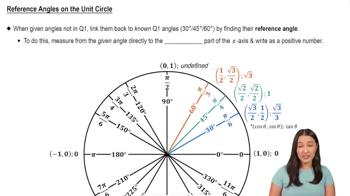
Reference Angles

A reference angle is the acute angle formed between the terminal side of an angle and the x-axis. It helps simplify trigonometric calculations by relating angles in different quadrants to their acute counterparts, allowing the use of known values for sine, cosine, and tangent.
Video consigliato:
Percorso guidato
5:31
Reference Angles on the Unit Circle

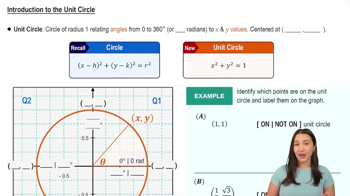
Unit Circle and Quadrants

The unit circle is a circle with radius 1 centered at the origin, used to define trigonometric functions for all angles. Understanding which quadrant an angle lies in determines the sign (positive or negative) of the trigonometric values based on the coordinate signs in that quadrant.
Video consigliato:
Percorso guidato
06:11
Introduction to the Unit Circle

Exact Values of Common Angles

Certain angles like 30°, 45°, 60°, and their multiples have known exact trigonometric values expressed in simplified radical form. Using these exact values avoids approximation and is essential when calculating trigonometric functions without a calculator.
Video consigliato:
Percorso guidato
3:47
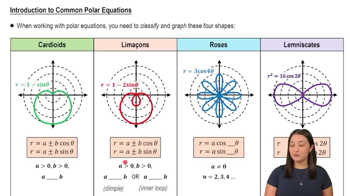
Introduction to Common Polar Equations