Ch. 1 - Angles and the Trigonometric Functions
Blitzer - Trigonometry 3rd Edition
Blitzer3rd EditionTrigonometryISBN: 9780137316601Non è quello che usi tu?Cambia libro di testo
Capitolo 1, Problema 8

In Exercises 8–12, draw each angle in standard position. 5𝜋 6

Guida verificata passo dopo passo
1
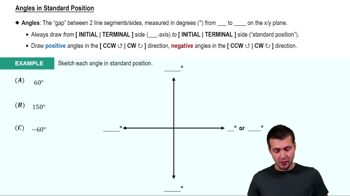
Understand that an angle in standard position is drawn with its vertex at the origin of the coordinate plane, its initial side along the positive x-axis, and the angle measured counterclockwise for positive angles.
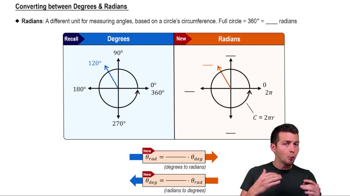
Identify the given angle: \(\frac{5\pi}{6}\). This is a radian measure, so recall that \(\pi\) radians equals 180 degrees.
Convert the angle to degrees if it helps visualization: multiply by \(\frac{180}{\pi}\) to get \(\frac{5\pi}{6} \times \frac{180}{\pi} = 150^\circ\).
Draw the initial side along the positive x-axis. From there, measure an angle of 150 degrees counterclockwise to locate the terminal side of the angle.
Mark the terminal side of the angle in the second quadrant, since 150 degrees is between 90 and 180 degrees, and label the angle as \(\frac{5\pi}{6}\) radians.

Risposta video verificata per un problema simile:

Questa soluzione video è stata consigliata dai nostri tutor come utile per risolvere questo problema.
Durata del video:
3m

Concetti chiave

Ecco i concetti essenziali che devi comprendere per rispondere correttamente alla domanda.

Standard Position of an Angle

An angle is in standard position when its vertex is at the origin of the coordinate plane, its initial side lies along the positive x-axis, and the angle is measured by rotating the initial side to the terminal side. Understanding this helps in accurately drawing and interpreting angles.
Video consigliato:
Percorso guidato
05:50
Drawing Angles in Standard Position

Radian Measure

Radian measure expresses angles based on the radius of a circle, where 2π radians equal 360 degrees. Knowing how to convert and interpret radians, such as 5π/6, is essential for drawing angles and solving trigonometric problems.
Video consigliato:
Percorso guidato
5:04
Converting between Degrees & Radians

Unit Circle and Reference Angles

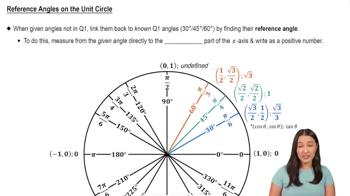
The unit circle is a circle with radius 1 centered at the origin, used to define trigonometric functions. Reference angles help determine the position of an angle's terminal side by relating it to a known acute angle, facilitating accurate drawing and analysis.
Video consigliato:
Percorso guidato
5:31
Reference Angles on the Unit Circle
Pratica correlata
Domanda del libro di testo

In Exercises 7–12, find the radian measure of the central angle of a circle of radius r that intercepts an arc of length s. Radius, r: 10 inches Arc Length, s: 40 inches

1042
views
Domanda del libro di testo

In Exercises 5–7, convert each angle in radians to degrees. - 5𝜋 6

557
views
Domanda del libro di testo

The unit circle has been divided into twelve equal arcs, corresponding to t-values of


0, 𝜋/6, 𝜋/3, 𝜋/2, 2𝜋/3, 5𝜋/6, 𝜋, 7𝜋/6, 4𝜋/3, 3𝜋/2, 5𝜋/3, 11𝜋/6, and 2𝜋


Use the (x,y) coordinates in the figure to find the value of each trigonometric function at the indicated real number, t, or state that the expression is undefined.

<IMAGE>


cos 5𝜋/6

506
views
Domanda del libro di testo

In Exercises 5–18, the unit circle has been divided into twelve equal arcs, corresponding to t-values of 0, 𝜋, 𝜋, 𝜋, 2𝜋, 5𝜋, 𝜋, 7𝜋, 4𝜋, 3𝜋, 5𝜋, 11𝜋, and 2𝜋. 6 3 2 3 6 6 3 2 3 6 Use the (x,y) coordinates in the figure to find the value of each trigonometric function at the indicated real number, t, or state that the expression is undefined.

cos 2𝜋/3

3308
views
1
rank
Domanda del libro di testo

In Exercises 7–12, find the radian measure of the central angle of a circle of radius r that intercepts an arc of length s. Radius, r: 6 yards Arc Length, s: 8 yards

699
views
Domanda del libro di testo

In Exercises 1–8, a point on the terminal side of angle θ is given. Find the exact value of each of the six trigonometric functions of θ. (-1, -3)

583
views