Ch. 1 - Angles and the Trigonometric Functions
Blitzer - Trigonometry 3rd Edition
Blitzer3rd EditionTrigonometryISBN: 9780137316601Non è quello che usi tu?Cambia libro di testo
Capitolo 1, Problema 9

In Exercises 9–16, use the given triangles to evaluate each expression. If necessary, express the value without a square root in the denominator by rationalizing the denominator.
Right triangle PQR with angles 30° and 60°, and sides labeled 1, 2, and √3.
cos 30°

Guida verificata passo dopo passo
1
Identify the angle for which you need to find the cosine value, which is 30° in this case.
Recall that cosine of an angle in a right triangle is defined as the ratio of the length of the adjacent side to the hypotenuse: \(\cos(\theta) = \frac{\text{adjacent}}{\text{hypotenuse}}\).
From the triangle, note that the side adjacent to the 30° angle is \(\sqrt{3}\) and the hypotenuse is 2.
Set up the cosine ratio for 30°: \(\cos 30^\circ = \frac{\sqrt{3}}{2}\).
Since the denominator is already rational, no further rationalization is needed.

Risposta video verificata per un problema simile:

Questa soluzione video è stata consigliata dai nostri tutor come utile per risolvere questo problema.
Durata del video:
1m

Concetti chiave

Ecco i concetti essenziali che devi comprendere per rispondere correttamente alla domanda.

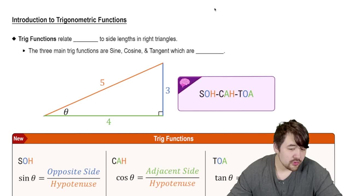
Trigonometric Ratios in Right Triangles

Trigonometric ratios such as sine, cosine, and tangent relate the angles of a right triangle to the ratios of its sides. For example, cosine of an angle is the ratio of the adjacent side to the hypotenuse. These ratios help evaluate expressions involving angles and side lengths.
Video consigliato:
Percorso guidato
6:04
Introduction to Trigonometric Functions

Special Right Triangles (30°-60°-90° Triangle)

A 30°-60°-90° triangle has side lengths in a fixed ratio: the side opposite 30° is half the hypotenuse, and the side opposite 60° is √3 times the shorter leg. This property allows quick determination of side lengths and trigonometric values without complex calculations.
Video consigliato:
Percorso guidato
04:39
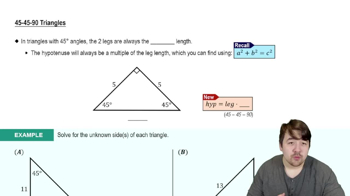
45-45-90 Triangles

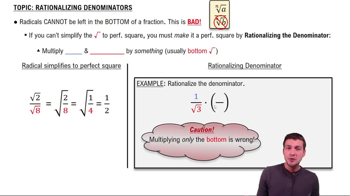
Rationalizing the Denominator

Rationalizing the denominator involves eliminating square roots from the denominator of a fraction by multiplying numerator and denominator by a suitable radical. This process simplifies expressions and is often required for final answers in trigonometry problems.
Video consigliato:
Percorso guidato
2:58
Rationalizing Denominators