Ch. 2 - Graphs of the Trigonometric Functions; Inverse Trigonometric Functions
Blitzer - Trigonometry 3rd Edition
Blitzer3rd EditionTrigonometryISBN: 9780137316601Non è quello che usi tu?Cambia libro di testo
Capitolo 2, Problema 17

In Exercises 1–26, find the exact value of each expression. _ tan⁻¹ (−√3)

Guida verificata passo dopo passo
1
Recognize that the expression is asking for the inverse tangent (arctangent) of \(-\sqrt{3}\), which means we want to find an angle \(\theta\) such that \(\tan(\theta) = -\sqrt{3}\).
Recall the basic angles where tangent values are known: \(\tan(\frac{\pi}{3}) = \sqrt{3}\) and \(\tan(\frac{\pi}{6}) = \frac{1}{\sqrt{3}}\). Since the value is \(-\sqrt{3}\), the angle must correspond to the negative of \(\tan(\frac{\pi}{3})\).
Determine the principal value range of the inverse tangent function, which is \(\left(-\frac{\pi}{2}, \frac{\pi}{2}\right)\), meaning the angle must lie in the first or fourth quadrant.
Find the angle in the fourth quadrant where tangent is negative and equals \(-\sqrt{3}\). This angle is the negative of \(\frac{\pi}{3}\), so \(\theta = -\frac{\pi}{3}\).
Express the final answer as \(\tan^{-1}(-\sqrt{3}) = -\frac{\pi}{3}\), which is the exact value within the principal range.

Risposta video verificata per un problema simile:

Questa soluzione video è stata consigliata dai nostri tutor come utile per risolvere questo problema.
Durata del video:
3m

Concetti chiave

Ecco i concetti essenziali che devi comprendere per rispondere correttamente alla domanda.

Inverse Tangent Function (tan⁻¹ or arctan)

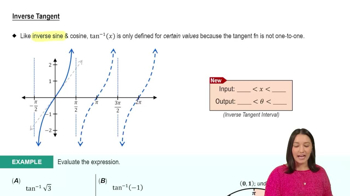
The inverse tangent function, denoted as tan⁻¹ or arctan, returns the angle whose tangent is a given number. It is used to find an angle when the ratio of the opposite side to the adjacent side in a right triangle is known. The output angle is typically in the range (-π/2, π/2) or (-90°, 90°).
Video consigliato:
Percorso guidato
3:17
Inverse Tangent

Exact Values of Tangent for Special Angles

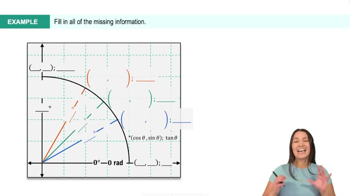
Certain angles have well-known tangent values, such as π/6, π/4, and π/3. For example, tan(π/3) = √3, so tan⁻¹(√3) = π/3. Recognizing these special values helps in finding exact angle measures without a calculator.
Video consigliato:

Handling Negative Arguments in Inverse Trigonometric Functions

When the input to an inverse trig function is negative, the resulting angle lies in the corresponding negative range of the function's principal values. For tan⁻¹(−√3), the angle is negative and corresponds to the angle whose tangent is √3 but reflected across the x-axis, typically -π/3.
Video consigliato:
Percorso guidato
4:28
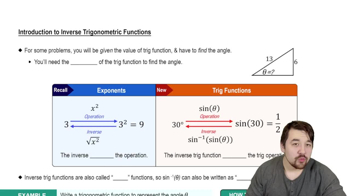
Introduction to Inverse Trig Functions