Ch. 2 - Graphs of the Trigonometric Functions; Inverse Trigonometric Functions
Blitzer - Trigonometry 3rd Edition
Blitzer3rd EditionTrigonometryISBN: 9780137316601Non è quello che usi tu?Cambia libro di testo
Capitolo 2, Problema 35

In Exercises 29–36, find the length x to the nearest whole unit.
Right triangle with angles 22° and 54°, base 200 units, height x to find.

Guida verificata passo dopo passo
1
Identify the right triangle and the given information: one angle is 22°, the other non-right angle is 54°, the base adjacent to the 22° angle is 200 units, and the height (opposite side to the 54° angle) is x, which we need to find.
Recall that in a right triangle, the sum of the two non-right angles is 90°, which matches the given angles 22° and 54°, confirming the triangle's angle measures.
Use the tangent function for the 54° angle, since tangent relates the opposite side to the adjacent side: \(\tan(54^\circ) = \frac{x}{200}\).
Rearrange the equation to solve for x: \(x = 200 \times \tan(54^\circ)\).
Calculate the value of \(\tan(54^\circ)\) using a calculator, then multiply by 200 to find the length x, rounding to the nearest whole unit.

Risposta video verificata per un problema simile:

Questa soluzione video è stata consigliata dai nostri tutor come utile per risolvere questo problema.
Durata del video:
5m

Concetti chiave

Ecco i concetti essenziali che devi comprendere per rispondere correttamente alla domanda.

Right Triangle Trigonometry

Right triangle trigonometry involves relationships between the angles and sides of a right triangle. The primary trigonometric ratios—sine, cosine, and tangent—relate an angle to the ratios of two sides, enabling the calculation of unknown side lengths or angles.
Video consigliato:
Percorso guidato
04:39
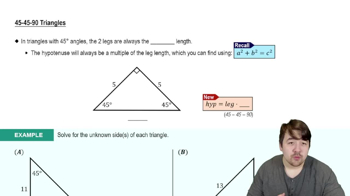
45-45-90 Triangles

Trigonometric Ratios (Sine, Cosine, Tangent)

Sine, cosine, and tangent are ratios defined for an acute angle in a right triangle: sine is opposite/hypotenuse, cosine is adjacent/hypotenuse, and tangent is opposite/adjacent. These ratios help find missing sides or angles when some measurements are known.
Video consigliato:
Percorso guidato
5:08
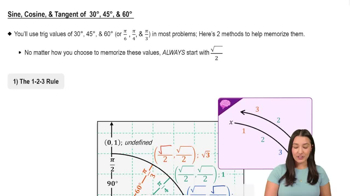
Sine, Cosine, & Tangent of 30°, 45°, & 60°

Angle Sum and Complementary Angles in Triangles

The sum of angles in any triangle is 180°. In a right triangle, the two acute angles are complementary, summing to 90°. Understanding this helps identify which trigonometric ratios to use based on the given angles and sides.
Video consigliato:
Percorso guidato
3:35
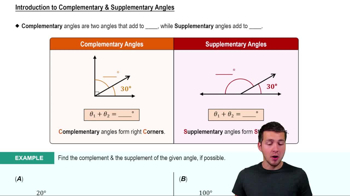
Intro to Complementary & Supplementary Angles