In Exercises 29–51, find the exact value of each expression. Do not use a calculator. tan [cos⁻¹ (− 4/5)]
Ch. 2 - Graphs of the Trigonometric Functions; Inverse Trigonometric Functions

Tutti i libri di testo
Blitzer 3rd Edition
Ch. 2 - Graphs of the Trigonometric Functions; Inverse Trigonometric Functions
Problema 45
Blitzer 3rd Edition
Ch. 2 - Graphs of the Trigonometric Functions; Inverse Trigonometric Functions
Problema 45Capitolo 2, Problema 45
In Exercises 29–51, find the exact value of each expression. Do not use a calculator. sin(cos⁻¹ 3/5)
Guida verificata passo dopo passo1
Recognize that the expression is \( \sin(\cos^{-1}(\frac{3}{5})) \). Here, \( \cos^{-1}(\frac{3}{5}) \) represents an angle \( \theta \) such that \( \cos(\theta) = \frac{3}{5} \).
Visualize or draw a right triangle where the adjacent side to angle \( \theta \) is 3 and the hypotenuse is 5, based on the cosine ratio \( \cos(\theta) = \frac{\text{adjacent}}{\text{hypotenuse}} \).
Use the Pythagorean theorem to find the length of the opposite side: \( \text{opposite} = \sqrt{5^2 - 3^2} = \sqrt{25 - 9} \).
Simplify the expression under the square root to find the opposite side length: \( \sqrt{16} \).
Calculate \( \sin(\theta) = \frac{\text{opposite}}{\text{hypotenuse}} = \frac{\sqrt{16}}{5} \), which gives the exact value of \( \sin(\cos^{-1}(\frac{3}{5})) \).

Risposta video verificata per un problema simile:
Questa soluzione video è stata consigliata dai nostri tutor come utile per risolvere questo problema.
Durata del video:
3mConcetti chiave
Ecco i concetti essenziali che devi comprendere per rispondere correttamente alla domanda.
Inverse Trigonometric Functions
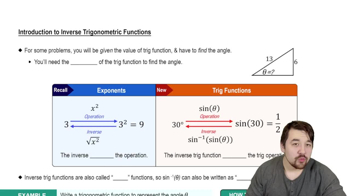
Inverse trigonometric functions, like cos⁻¹(x), return the angle whose trigonometric ratio equals x. For example, cos⁻¹(3/5) gives the angle θ such that cos(θ) = 3/5. Understanding this allows us to interpret expressions involving inverse functions as angles.
Video consigliato:
Percorso guidato
Introduction to Inverse Trig Functions
Right Triangle Relationships
Using the value of cos(θ) = adjacent/hypotenuse, we can construct a right triangle with sides 3 (adjacent) and 5 (hypotenuse). The Pythagorean theorem helps find the opposite side, enabling us to find sin(θ) based on triangle side ratios.
Video consigliato:
Percorso guidato
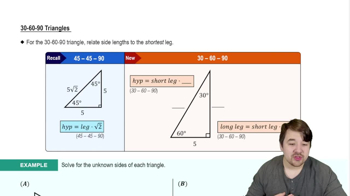
30-60-90 Triangles
Pythagorean Identity
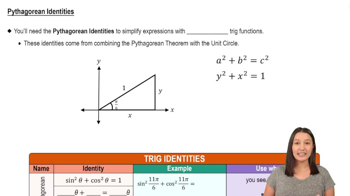
The Pythagorean identity states sin²(θ) + cos²(θ) = 1. Given cos(θ), we can find sin(θ) by rearranging to sin(θ) = ±√(1 - cos²(θ)). This identity is essential for finding the sine of an angle when only the cosine is known.
Video consigliato:
Percorso guidato
Pythagorean Identities
Pratica correlata
Domanda del libro di testo
786
views
Domanda del libro di testo
In Exercises 43–52, determine the amplitude, period, and phase shift of each function. Then graph one period of the function. y = 3 cos(2x − π)
572
views
Domanda del libro di testo
In Exercises 39–54, find the exact value of each expression, if possible. Do not use a calculator. tan (tan⁻¹ 125)
733
views
Domanda del libro di testo
Determine the amplitude, period, and phase shift of each function. Then graph one period of the function.
y = cos(x + π/2)
495
views
Domanda del libro di testo
In Exercises 43–52, determine the amplitude, period, and phase shift of each function. Then graph one period of the function. y = 1/2 cos (3x + π/2)
553
views
Domanda del libro di testo
Determine the amplitude, period, and phase shift of each function. Then graph one period of the function.
y = 4 cos(2x − π)
581
views