Ch. 2 - Graphs of the Trigonometric Functions; Inverse Trigonometric Functions
Blitzer - Trigonometry 3rd Edition
Blitzer3rd EditionTrigonometryISBN: 9780137316601Non è quello che usi tu?Cambia libro di testo
Capitolo 2, Problema 39

In Exercises 35–42, determine the amplitude and period of each function. Then graph one period of the function. y = -4 cos 1/2 x

Guida verificata passo dopo passo
1
Identify the general form of the cosine function, which is \(y = A \cos(Bx)\), where \(A\) represents the amplitude and \(B\) affects the period of the function.
Determine the amplitude by taking the absolute value of the coefficient in front of the cosine function. For \(y = -4 \cos \frac{1}{2} x\), the amplitude is \(| -4 |\).
Calculate the period using the formula \(\text{Period} = \frac{2\pi}{|B|}\), where \(B\) is the coefficient of \(x\) inside the cosine function. Here, \(B = \frac{1}{2}\).
Substitute \(B = \frac{1}{2}\) into the period formula to find the length of one full cycle of the cosine wave.
To graph one period, plot points starting from \(x = 0\) to \(x = \text{Period}\), using the amplitude to determine the maximum and minimum values of the function, and remember the negative sign reflects the graph over the x-axis.

Risposta video verificata per un problema simile:

Questa soluzione video è stata consigliata dai nostri tutor come utile per risolvere questo problema.
Durata del video:
7m

Concetti chiave

Ecco i concetti essenziali che devi comprendere per rispondere correttamente alla domanda.

Amplitude of a Trigonometric Function

Amplitude is the maximum absolute value of the function's output, representing the height from the midline to the peak of the wave. For functions like y = a cos(bx), the amplitude is |a|. In this question, the amplitude is the absolute value of -4, which is 4.
Video consigliato:
Percorso guidato
6:04
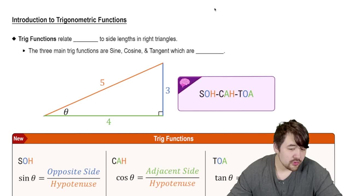
Introduction to Trigonometric Functions

Period of a Trigonometric Function

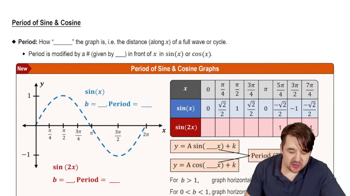
The period is the length of one complete cycle of the function along the x-axis. For y = cos(bx), the period is calculated as (2π) / |b|. Here, b = 1/2, so the period is 2π divided by 1/2, which equals 4π.
Video consigliato:
Percorso guidato
5:33
Period of Sine and Cosine Functions

Graphing One Period of a Cosine Function

Graphing one period involves plotting the function from the start of one cycle to the end, typically over one period length on the x-axis. Key points include the maximum, minimum, and intercepts, adjusted by amplitude and period. For y = -4 cos(1/2 x), the graph oscillates between -4 and 4 over an interval of 4π.
Video consigliato:
Percorso guidato
5:33
Period of Sine and Cosine Functions