Ch. 2 - Graphs of the Trigonometric Functions; Inverse Trigonometric Functions
Blitzer - Trigonometry 3rd Edition
Blitzer3rd EditionTrigonometryISBN: 9780137316601Non è quello che usi tu?Cambia libro di testo
Capitolo 2, Problema 9

Graph two periods of the given tangent function. y = −2 tan (1/2) x

Guida verificata passo dopo passo
1
Identify the general form of the tangent function: \(y = a \tan(bx)\), where \(a\) affects the amplitude (vertical stretch) and \(b\) affects the period of the function.
Determine the period of the function using the formula for tangent: \(\text{Period} = \frac{\pi}{|b|}\). Here, \(b = \frac{1}{2}\), so calculate the period as \(\frac{\pi}{\frac{1}{2}}\).
Calculate the period explicitly: \(\frac{\pi}{\frac{1}{2}} = 2\pi\). This means one full cycle of the tangent function occurs over an interval of length \(2\pi\).
Since the problem asks for two periods, plan to graph the function over an interval of length \(2 \times 2\pi = 4\pi\). This will cover two full cycles of the tangent function.
Note the vertical stretch and reflection: the coefficient \(-2\) means the graph is vertically stretched by a factor of 2 and reflected across the x-axis. Use this to sketch the graph accordingly, marking key points such as vertical asymptotes where the tangent function is undefined.

Risposta video verificata per un problema simile:

Questa soluzione video è stata consigliata dai nostri tutor come utile per risolvere questo problema.
Durata del video:
8m

Concetti chiave

Ecco i concetti essenziali che devi comprendere per rispondere correttamente alla domanda.

Period of the Tangent Function

The period of the basic tangent function y = tan(x) is π. When the function is transformed to y = tan(bx), the period changes to π divided by the absolute value of b. Understanding this helps determine the length of one full cycle to graph two periods accurately.
Video consigliato:
Percorso guidato
5:43
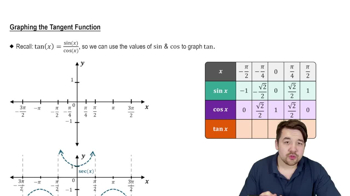
Introduction to Tangent Graph

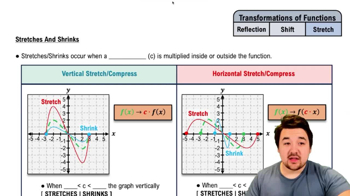
Amplitude and Vertical Stretch

Although tangent functions do not have a maximum amplitude, the coefficient outside the function, such as -2 in y = -2 tan(½x), vertically stretches the graph by a factor of 2 and reflects it across the x-axis. This affects the steepness and direction of the graph's slopes.
Video consigliato:
Percorso guidato
6:02
Stretches and Shrinks of Functions

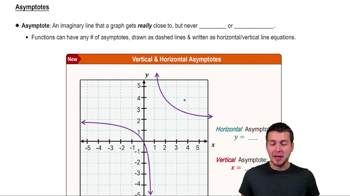
Asymptotes of the Tangent Function

Tangent functions have vertical asymptotes where the function is undefined, occurring at x-values where the cosine is zero. For y = tan(bx), asymptotes occur at x = (π/2 + kπ)/b. Identifying these asymptotes is essential for correctly sketching the graph.
Video consigliato: