Ch. 2 - Graphs of the Trigonometric Functions; Inverse Trigonometric Functions
Blitzer - Trigonometry 3rd Edition
Blitzer3rd EditionTrigonometryISBN: 9780137316601Non è quello che usi tu?Cambia libro di testo
Capitolo 2, Problema 55

In Exercises 55–62, use the properties of inverse functions f(f⁻¹ (x)) = x for all x in the domain of f⁻¹ and f⁻¹(f(x)) for all x in the domain of f, as well as the definitions of the inverse cotangent, cosecant, and secant functions, to find the exact value of each expression, if possible. cot(cot⁻¹ 9π)

Guida verificata passo dopo passo
1
Recall the property of inverse functions: for any function \( f \) and its inverse \( f^{-1} \), \( f(f^{-1}(x)) = x \) for all \( x \) in the domain of \( f^{-1} \).
Identify the function and its inverse in the expression: here, \( f = \cot \) and \( f^{-1} = \cot^{-1} \), so the expression \( \cot(\cot^{-1}(9\pi)) \) fits the form \( f(f^{-1}(x)) \).
Check the domain of the inverse cotangent function \( \cot^{-1} \). The principal value of \( \cot^{-1}(x) \) is usually defined to be in the interval \( (0, \pi) \). Since \( 9\pi \) is a positive number, \( \cot^{-1}(9\pi) \) is within the domain of \( \cot \).
Apply the inverse function property: \( \cot(\cot^{-1}(9\pi)) = 9\pi \), because the output of \( \cot^{-1}(9\pi) \) is an angle whose cotangent is \( 9\pi \).
Therefore, the exact value of the expression \( \cot(\cot^{-1}(9\pi)) \) is \( 9\pi \).

Risposta video verificata per un problema simile:

Questa soluzione video è stata consigliata dai nostri tutor come utile per risolvere questo problema.
Durata del video:
1m

Concetti chiave

Ecco i concetti essenziali che devi comprendere per rispondere correttamente alla domanda.

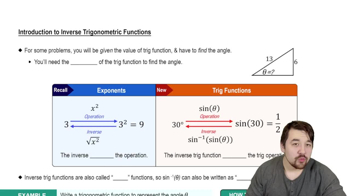
Inverse Trigonometric Functions

Inverse trigonometric functions reverse the effect of their corresponding trigonometric functions, returning an angle when given a ratio. For example, cot⁻¹(x) gives the angle whose cotangent is x. Understanding their domains and ranges is essential to correctly evaluate expressions involving these functions.
Video consigliato:
Percorso guidato
4:28
Introduction to Inverse Trig Functions

Properties of Inverse Functions

The key property f(f⁻¹(x)) = x holds for all x in the domain of f⁻¹, meaning applying a function and its inverse in succession returns the original input. Similarly, f⁻¹(f(x)) = x for all x in the domain of f. This property helps simplify expressions like cot(cot⁻¹(9π)) to 9π, provided the value lies within the appropriate domain.
Video consigliato:
Percorso guidato
4:28
Introduction to Inverse Trig Functions

Domain and Range Restrictions of Cotangent and Its Inverse

The cotangent function is not one-to-one over all real numbers, so its inverse cot⁻¹ is defined with a restricted range, typically (0, π). This restriction ensures the inverse is a function. When evaluating cot(cot⁻¹(x)), the result equals x only if x is within the range of cot on (0, π), otherwise adjustments or interpretations are needed.
Video consigliato:
Percorso guidato
4:22
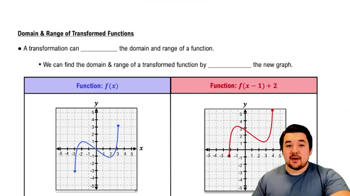
Domain and Range of Function Transformations