In Exercises 21–28, an object moves in simple harmonic motion described by the given equation, where t is measured in seconds and d in inches. In each exercise, find the following: a. the maximum displacement b. the frequency c. the time required for one cycle. d = −4 sin 3π/2 t
Ch. 2 - Graphs of the Trigonometric Functions; Inverse Trigonometric Functions

Tutti i libri di testo
Blitzer 3rd Edition
Ch. 2 - Graphs of the Trigonometric Functions; Inverse Trigonometric Functions
Problema 28
Blitzer 3rd Edition
Ch. 2 - Graphs of the Trigonometric Functions; Inverse Trigonometric Functions
Problema 28Capitolo 2, Problema 28
Use each graph to obtain the graph of the corresponding reciprocal function, cosecant or secant. Give the equation of the function for the graph that you obtain.
<IMAGE>
Guida verificata passo dopo passo1
Identify the original trigonometric function from the given graph, which will be either sine or cosine, since their reciprocals are cosecant and secant respectively.
Recall that the reciprocal function of sine is cosecant, defined as \(y = \csc x = \frac{1}{\sin x}\), and the reciprocal function of cosine is secant, defined as \(y = \sec x = \frac{1}{\cos x}\).
Note the key features of the original graph: where the function crosses the x-axis (zeros), where it has maximum and minimum values, and its period. These features help determine the behavior of the reciprocal function.
Use the fact that the reciprocal function will have vertical asymptotes where the original function is zero, because division by zero is undefined. For example, if the original function is \(\sin x\), then \(\csc x\) has vertical asymptotes where \(\sin x = 0\).
Sketch the reciprocal graph by plotting points where the original function has maximum and minimum values (these become the minimum and maximum points of the reciprocal), and draw vertical asymptotes at the zeros of the original function. Finally, write the equation of the reciprocal function based on the original function identified.

Risposta video verificata per un problema simile:
Questa soluzione video è stata consigliata dai nostri tutor come utile per risolvere questo problema.
Durata del video:
5mConcetti chiave
Ecco i concetti essenziali che devi comprendere per rispondere correttamente alla domanda.
Reciprocal Trigonometric Functions
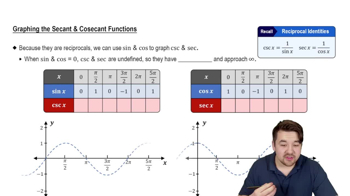
Reciprocal functions like cosecant (csc) and secant (sec) are defined as the reciprocals of sine and cosine, respectively. Specifically, csc(x) = 1/sin(x) and sec(x) = 1/cos(x). Understanding these relationships is essential to transform sine or cosine graphs into their reciprocal counterparts.
Video consigliato:
Percorso guidato
Introduction to Trigonometric Functions
Graphing Reciprocal Functions
To graph reciprocal functions, identify points where the original sine or cosine function is zero, as these correspond to vertical asymptotes in the reciprocal graph. The reciprocal graph will have peaks where the original function has maxima or minima, and it will never cross the x-axis since the reciprocal of zero is undefined.
Video consigliato:
Percorso guidato
Graphs of Secant and Cosecant Functions
Equation Identification from Graphs
Determining the equation from a graph involves recognizing amplitude, period, phase shift, and vertical shift. For reciprocal functions, these parameters come from the original sine or cosine function before taking the reciprocal. Accurately identifying these features allows writing the correct cosecant or secant function equation.
Video consigliato:
Percorso guidato
Convert Equations from Polar to Rectangular
Pratica correlata
Domanda del libro di testo
1160
views
Domanda del libro di testo
In Exercises 27–38, use a calculator to find the value of each expression rounded to two decimal places. sin⁻¹ 0.3
743
views
Domanda del libro di testo
In Exercises 17–30, determine the amplitude, period, and phase shift of each function. Then graph one period of the function. y = −2 sin(2πx + 4π)
561
views
Domanda del libro di testo
Determine the amplitude, period, and phase shift of each function. Then graph one period of the function.
y = 3 sin(πx + 2)
614
views
Domanda del libro di testo
In Exercises 25–28, use each graph to obtain the graph of the corresponding reciprocal function, cosecant or secant. Give the equation of the function for the graph that you obtain.
827
views
Domanda del libro di testo
In Exercises 29–36, find the length x to the nearest whole unit.
462
views