Ch. 3 - Trigonometric Identities and Equations
Blitzer - Trigonometry 3rd Edition
Blitzer3rd EditionTrigonometryISBN: 9780137316601Non è quello che usi tu?Cambia libro di testo
Capitolo 3, Problema 3.5.55

In Exercises 53–62, solve each equation on the interval [0, 2𝝅). (2 cos x + √ 3) (2 sin x + 1) = 0

Guida verificata passo dopo passo
1
Recognize that the equation is a product of two factors equal to zero: \((2 \cos x + \sqrt{3})(2 \sin x + 1) = 0\). According to the zero product property, set each factor equal to zero separately.
Set the first factor equal to zero: \(2 \cos x + \sqrt{3} = 0\). Solve for \(\cos x\) to get \(\cos x = -\frac{\sqrt{3}}{2}\).
Set the second factor equal to zero: \(2 \sin x + 1 = 0\). Solve for \(\sin x\) to get \(\sin x = -\frac{1}{2}\).
Find all values of \(x\) in the interval \([0, 2\pi)\) that satisfy \(\cos x = -\frac{\sqrt{3}}{2}\). Recall the unit circle values where cosine equals this value and note the corresponding angles.
Find all values of \(x\) in the interval \([0, 2\pi)\) that satisfy \(\sin x = -\frac{1}{2}\). Use the unit circle to identify the angles where sine equals this value within the given interval.

Risposta video verificata per un problema simile:

Questa soluzione video è stata consigliata dai nostri tutor come utile per risolvere questo problema.
Durata del video:
10m

Concetti chiave

Ecco i concetti essenziali che devi comprendere per rispondere correttamente alla domanda.

Zero Product Property

This property states that if the product of two factors equals zero, then at least one of the factors must be zero. In the given equation, (2 cos x + √3)(2 sin x + 1) = 0, we set each factor equal to zero separately to find possible solutions for x.
Video consigliato:
Percorso guidato
05:40
Introduction to Dot Product

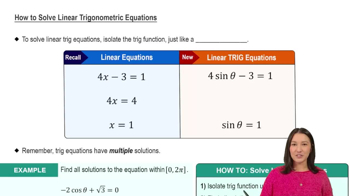
Solving Basic Trigonometric Equations

To solve equations like 2 cos x + √3 = 0 or 2 sin x + 1 = 0, isolate the trigonometric function and find the angle(s) x within the interval [0, 2π) that satisfy the equation. This involves using inverse sine or cosine functions and considering the unit circle.
Video consigliato:
Percorso guidato
4:34
How to Solve Linear Trigonometric Equations

Interval Restriction and Unit Circle

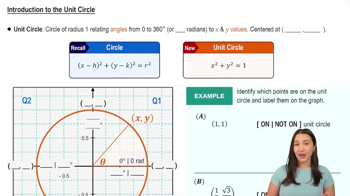
The solutions must lie within the interval [0, 2π), representing one full rotation on the unit circle. Understanding the unit circle helps identify all angles where sine or cosine take specific values, ensuring all valid solutions are found within the given domain.
Video consigliato:
Percorso guidato
06:11
Introduction to the Unit Circle