Ch. 3 - Trigonometric Identities and Equations
Blitzer - Trigonometry 3rd Edition
Blitzer3rd EditionTrigonometryISBN: 9780137316601Non è quello che usi tu?Cambia libro di testo
Capitolo 3, Problema 87

In Exercises 85–96, use a calculator to solve each equation, correct to four decimal places, on the interval [0, 2𝝅). cos x = ﹣ 2/5

Guida verificata passo dopo passo
1
Rewrite the equation clearly: \(\cos^2 x = -\frac{2}{5}\). This means the square of cosine of \(x\) equals a negative number.
Recall that \(\cos^2 x\) represents the square of the cosine function, which is always greater than or equal to zero for all real \(x\) because squaring any real number cannot produce a negative result.
Since \(\cos^2 x\) cannot be negative, analyze the equation \(\cos^2 x = -\frac{2}{5}\) and recognize that it has no real solutions because the right side is negative.
Conclude that there are no values of \(x\) in the interval \([0, 2\pi)\) that satisfy the equation \(\cos^2 x = -\frac{2}{5}\).
Therefore, the solution set is empty; no solutions exist for this equation within the given interval.

Risposta video verificata per un problema simile:

Questa soluzione video è stata consigliata dai nostri tutor come utile per risolvere questo problema.
Durata del video:
3m

Concetti chiave

Ecco i concetti essenziali che devi comprendere per rispondere correttamente alla domanda.

Solving Trigonometric Equations

Solving trigonometric equations involves finding all angle values within a specified interval that satisfy the given equation. This requires understanding the periodic nature of trigonometric functions and applying inverse functions to isolate the variable.
Video consigliato:
Percorso guidato
4:34
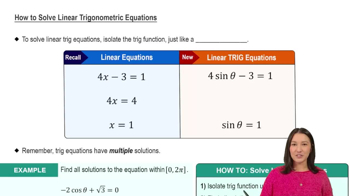
How to Solve Linear Trigonometric Equations

Using the Inverse Cosine Function

The inverse cosine function, denoted as cos⁻¹ or arccos, is used to find the angle whose cosine value is known. Since cosine is positive in the first and fourth quadrants, solutions must be considered accordingly within the interval [0, 2π).
Video consigliato:
Percorso guidato
4:49
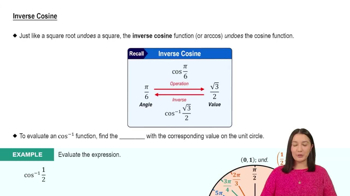
Inverse Cosine

Calculator Use and Rounding

Using a calculator to solve trigonometric equations involves inputting values correctly and interpreting results in radians or degrees as required. Rounding answers to four decimal places ensures precision and consistency in the final solutions.
Video consigliato:
Percorso guidato
4:45
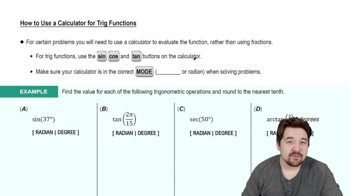
How to Use a Calculator for Trig Functions