
Domanda del libro di testo
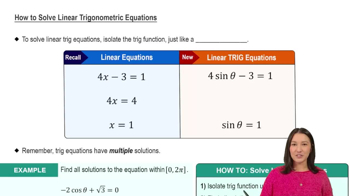
In Exercises 85–96, use a calculator to solve each equation, correct to four decimal places, on the interval [0, 2𝝅). 7 sin² x - 1 = 0
497
views

 Guida verificata passo dopo passo
 4:34
4:34
 3:43
3:43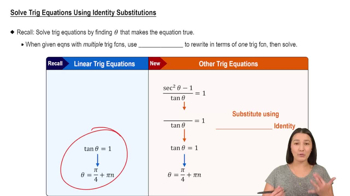 04:42
04:42In Exercises 85–96, use a calculator to solve each equation, correct to four decimal places, on the interval [0, 2𝝅). 7 sin² x - 1 = 0
In Exercises 97–116, use the most appropriate method to solve each equation on the interval [0, 2𝝅). Use exact values where possible or give approximate solutions correct to four decimal places. sin 2x + sin x = 0
In Exercises 97–116, use the most appropriate method to solve each equation on the interval [0, 2𝝅). Use exact values where possible or give approximate solutions correct to four decimal places. 2 cos 2x + 1 = 0
In Exercises 97–116, use the most appropriate method to solve each equation on the interval [0, 2𝝅). Use exact values where possible or give approximate solutions correct to four decimal places. 2 sin² x = 3 - sin x
In Exercises 97–116, use the most appropriate method to solve each equation on the interval [0, 2𝝅). Use exact values where possible or give approximate solutions correct to four decimal places. tan x sec x = 2 tan x
In Exercises 97–116, use the most appropriate method to solve each equation on the interval [0, 2𝝅). Use exact values where possible or give approximate solutions correct to four decimal places. 5 cot² x - 15 = 0