Ch. 4 - Laws of Sines and Cosines; Vectors
Blitzer - Trigonometry 3rd Edition
Blitzer3rd EditionTrigonometryISBN: 9780137316601Non è quello che usi tu?Cambia libro di testo
Capitolo 4, Problema 7

In Exercises 1–12, solve each triangle. Round lengths to the nearest tenth and angle measures to the nearest degree. If no triangle exists, state 'no triangle.' If two triangles exist, solve each triangle. C = 50°, a = 3, c = 1

Guida verificata passo dopo passo
1
Identify the given elements of the triangle: angle \(C = 50^\circ\), side \(a = 3\), and side \(c = 1\). We need to solve the triangle, which means finding the remaining angles \(A\) and \(B\), and side \(b\).
Use the Law of Sines, which states: \(\frac{a}{\sin A} = \frac{c}{\sin C}\). Substitute the known values to set up the equation: \(\frac{3}{\sin A} = \frac{1}{\sin 50^\circ}\).
Solve for \(\sin A\) by cross-multiplying: \(\sin A = 3 \times \frac{\sin 50^\circ}{1} = 3 \sin 50^\circ\). Calculate \(3 \sin 50^\circ\) to check if it is less than or equal to 1, which determines if a triangle exists.
If \(\sin A\) is greater than 1, then no triangle exists. If \(\sin A\) is less than or equal to 1, find angle \(A\) by taking the inverse sine: \(A = \sin^{-1}(3 \sin 50^\circ)\). Remember that the sine function can have two possible angles in the range \(0^\circ\) to \(180^\circ\), so consider both possible values for \(A\) to check if two triangles exist.
Once you find the possible values for \(A\), calculate angle \(B\) using the triangle angle sum property: \(B = 180^\circ - A - C\). Then use the Law of Sines again to find side \(b\): \(\frac{b}{\sin B} = \frac{a}{\sin A}\). Round all lengths to the nearest tenth and angles to the nearest degree.

Risposta video verificata per un problema simile:

Questa soluzione video è stata consigliata dai nostri tutor come utile per risolvere questo problema.
Durata del video:
3m

Concetti chiave

Ecco i concetti essenziali che devi comprendere per rispondere correttamente alla domanda.

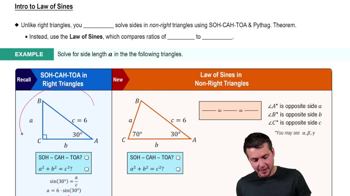
Law of Sines

The Law of Sines relates the ratios of the lengths of sides of a triangle to the sines of their opposite angles. It is expressed as (a/sin A) = (b/sin B) = (c/sin C). This law is essential for solving triangles when given two sides and a non-included angle (SSA), as in this problem.
Video consigliato:
Percorso guidato
4:27
Intro to Law of Sines

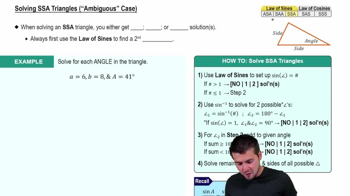
Ambiguous Case of SSA Triangles

When given two sides and a non-included angle (SSA), there can be zero, one, or two possible triangles. This is known as the ambiguous case. Determining the number of solutions involves checking the height and comparing side lengths to decide if no triangle, one triangle, or two triangles exist.
Video consigliato:
Percorso guidato
9:50
Solving SSA Triangles ("Ambiguous" Case)

Triangle Angle Sum Property

The sum of the interior angles of any triangle is always 180°. After finding one or two unknown angles using the Law of Sines, this property helps calculate the remaining angle(s) to complete the triangle solution.
Video consigliato:
Percorso guidato
4:47
Sum and Difference of Tangent