Ch. 4 - Laws of Sines and Cosines; Vectors
Blitzer - Trigonometry 3rd Edition
Blitzer3rd EditionTrigonometryISBN: 9780137316601Non è quello che usi tu?Cambia libro di testo
Capitolo 4, Problema 1

In Exercises 1–8, solve each triangle. Round lengths of sides to the nearest tenth and angle measures to the nearest degree.

Guida verificata passo dopo passo
1
Identify the type of triangle problem you are dealing with: whether you have two sides and an included angle (SAS), two angles and a side (ASA or AAS), or three sides (SSS). This will determine which trigonometric rules to apply.
If you have two sides and the included angle (SAS), use the Law of Cosines to find the third side. The Law of Cosines formula is: \(c^2 = a^2 + b^2 - 2ab \cos(C)\), where \(C\) is the known angle opposite side \(c\).
Once you have all three sides, or if you started with two angles and a side (ASA or AAS), use the Law of Sines to find the unknown angles or sides. The Law of Sines states: \(\frac{a}{\sin(A)} = \frac{b}{\sin(B)} = \frac{c}{\sin(C)}\).
Remember that the sum of the interior angles of a triangle is always 180 degrees. Use this fact to find any missing angle once you know two angles: \(A + B + C = 180^\circ\).
After calculating all sides and angles, round the side lengths to the nearest tenth and the angle measures to the nearest degree as instructed.

Risposta video verificata per un problema simile:

Questa soluzione video è stata consigliata dai nostri tutor come utile per risolvere questo problema.

Concetti chiave

Ecco i concetti essenziali che devi comprendere per rispondere correttamente alla domanda.

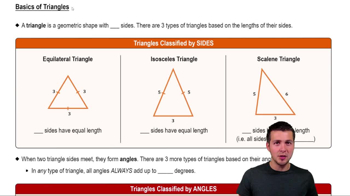
Types of Triangles and Their Properties

Understanding whether a triangle is right, acute, or obtuse is essential because it determines which trigonometric methods apply. Recognizing side lengths and angle measures helps in choosing the correct approach to solve the triangle.
Video consigliato:
Percorso guidato
4:42
Review of Triangles

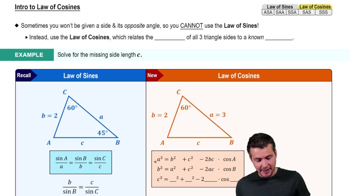
Law of Sines and Law of Cosines

These laws relate the sides and angles of any triangle, enabling the calculation of unknown parts. The Law of Sines is useful when given two angles and one side or two sides and a non-included angle, while the Law of Cosines applies when two sides and the included angle or all three sides are known.
Video consigliato:
Percorso guidato
4:35
Intro to Law of Cosines

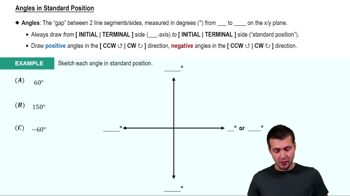
Rounding and Angle Measurement Conventions

Accurate rounding of side lengths to the nearest tenth and angles to the nearest degree ensures clarity and precision in answers. Understanding degree measurement and the use of calculators in degree mode is important for consistent results.
Video consigliato:
Percorso guidato
05:50
Drawing Angles in Standard Position