Ch. 4 - Laws of Sines and Cosines; Vectors
Blitzer - Trigonometry 3rd Edition
Blitzer3rd EditionTrigonometryISBN: 9780137316601Non è quello che usi tu?Cambia libro di testo
Capitolo 4, Problema 1

In Exercises 1–8, use the given vectors to find v⋅w and v⋅v. v = 3i + j, w = i + 3j

Guida verificata passo dopo passo
1
Identify the components of the vectors \( \mathbf{v} = 3\mathbf{i} + \mathbf{j} \) and \( \mathbf{w} = \mathbf{i} + 3\mathbf{j} \). Here, \( \mathbf{v} = (3, 1) \) and \( \mathbf{w} = (1, 3) \).
Recall the formula for the dot product of two vectors \( \mathbf{a} = (a_1, a_2) \) and \( \mathbf{b} = (b_1, b_2) \): \[ \mathbf{a} \cdot \mathbf{b} = a_1 b_1 + a_2 b_2 \]
Calculate \( \mathbf{v} \cdot \mathbf{w} \) by multiplying corresponding components and adding the results: \[ \mathbf{v} \cdot \mathbf{w} = 3 \times 1 + 1 \times 3 \]
Recall that \( \mathbf{v} \cdot \mathbf{v} \) is the dot product of \( \mathbf{v} \) with itself, which gives the square of its magnitude: \[ \mathbf{v} \cdot \mathbf{v} = 3 \times 3 + 1 \times 1 \]
Evaluate the sums from steps 3 and 4 to find the values of \( \mathbf{v} \cdot \mathbf{w} \) and \( \mathbf{v} \cdot \mathbf{v} \) respectively.

Risposta video verificata per un problema simile:

Questa soluzione video è stata consigliata dai nostri tutor come utile per risolvere questo problema.
Durata del video:
2m

Concetti chiave

Ecco i concetti essenziali che devi comprendere per rispondere correttamente alla domanda.

Dot Product of Vectors

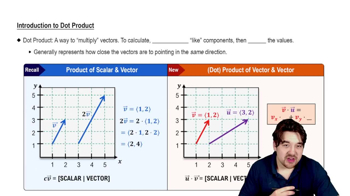
The dot product is an algebraic operation that takes two vectors and returns a scalar. It is calculated by multiplying corresponding components of the vectors and summing the results. For vectors v = (v1, v2) and w = (w1, w2), the dot product is v⋅w = v1w1 + v2w2.
Video consigliato:
Percorso guidato
05:40
Introduction to Dot Product

Vector Components and Notation

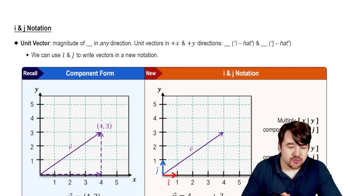
Vectors in two dimensions are often expressed in terms of unit vectors i and j, representing the x and y directions respectively. For example, v = 3i + j means the vector has components (3, 1). Understanding this notation is essential for performing operations like the dot product.
Video consigliato:

Properties of the Dot Product

The dot product is commutative, meaning v⋅w = w⋅v, and distributive over vector addition. Also, the dot product of a vector with itself, v⋅v, gives the square of its magnitude, which is useful for finding vector lengths and angles between vectors.
Video consigliato:
Percorso guidato
05:40
Introduction to Dot Product