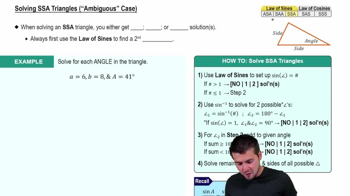
In Exercises 17–32, two sides and an angle (SSA) of a triangle are given. Determine whether the given measurements produce one triangle, two triangles, or no triangle at all. Solve each triangle that results. Round to the nearest tenth and the nearest degree for sides and angles, respectively.
a = 57.5, c = 49.8, A = 136°
Guida verificata passo dopo passo
1
Step 1: Identify the given information. You have side a = 57.5, side c = 49.8, and angle A = 136°. This is an SSA (Side-Side-Angle) case.
Step 2: Use the Law of Sines to find angle C. The Law of Sines states: \( \frac{a}{\sin A} = \frac{c}{\sin C} \). Substitute the known values into the equation.
Step 3: Solve for \( \sin C \) using the equation from Step 2. Calculate \( \sin C = \frac{c \cdot \sin A}{a} \).
Step 4: Determine if \( \sin C \) is valid. If \( \sin C > 1 \), no triangle is possible. If \( \sin C = 1 \), one right triangle is possible. If \( \sin C < 1 \), calculate angle C using \( C = \sin^{-1}(\sin C) \).
Step 5: Check for the possibility of a second triangle. If angle C is acute, calculate the possible second angle C' as \( C' = 180° - C \). Verify if the sum of angles A and C' is less than 180° to determine if a second triangle is possible.
Risposta video verificata per un problema simile:
Questa soluzione video è stata consigliata dai nostri tutor come utile per risolvere questo problema.
Guarda un video:
0 Commenti
Concetti chiave
Ecco i concetti essenziali che devi comprendere per rispondere correttamente alla domanda.
Law of Sines
The Law of Sines relates the ratios of the lengths of sides of a triangle to the sines of its opposite angles. It is expressed as a/b = sin(A)/sin(B) = c/sin(C). This law is particularly useful in SSA (Side-Side-Angle) cases, allowing us to determine unknown angles and sides when two sides and a non-included angle are known.
The SSA condition can lead to an ambiguous situation where two different triangles may be formed, one triangle may be formed, or no triangle may exist at all. This ambiguity arises because the given angle may not uniquely determine the triangle's shape. Understanding how to analyze this case is crucial for solving problems involving SSA.
The Triangle Sum Theorem states that the sum of the interior angles of a triangle is always 180 degrees. This theorem is essential for finding unknown angles in a triangle once some angles are known, especially in SSA scenarios where one angle is given and others need to be calculated based on the Law of Sines.


 Guida verificata passo dopo passo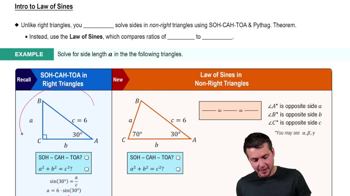
 4:27
4:27