Ch. 4 - Laws of Sines and Cosines; Vectors
Blitzer - Trigonometry 3rd Edition
Blitzer3rd EditionTrigonometryISBN: 9780137316601Non è quello che usi tu?Cambia libro di testo
Capitolo 4, Problema 31

In Exercises 21–38, let u = 2i - 5j, v = -3i + 7j, and w = -i - 6j. Find each specified vector or scalar.
3w + 2v

Guida verificata passo dopo passo
1
Identify the given vectors: \( \mathbf{u} = 2\mathbf{i} - 5\mathbf{j} \), \( \mathbf{v} = -3\mathbf{i} + 7\mathbf{j} \), and \( \mathbf{w} = -\mathbf{i} - 6\mathbf{j} \).
Calculate the scalar multiplication of vector \( \mathbf{w} \) by 3: multiply each component of \( \mathbf{w} \) by 3, resulting in \( 3\mathbf{w} = 3(-\mathbf{i}) + 3(-6\mathbf{j}) \).
Calculate the scalar multiplication of vector \( \mathbf{v} \) by 2: multiply each component of \( \mathbf{v} \) by 2, resulting in \( 2\mathbf{v} = 2(-3\mathbf{i}) + 2(7\mathbf{j}) \).
Add the resulting vectors from the previous two steps component-wise: add the \( \mathbf{i} \) components together and the \( \mathbf{j} \) components together to find \( 3\mathbf{w} + 2\mathbf{v} \).
Write the final vector in the form \( a\mathbf{i} + b\mathbf{j} \), where \( a \) and \( b \) are the sums of the respective components.

Risposta video verificata per un problema simile:

Questa soluzione video è stata consigliata dai nostri tutor come utile per risolvere questo problema.
Durata del video:
2m

Concetti chiave

Ecco i concetti essenziali che devi comprendere per rispondere correttamente alla domanda.

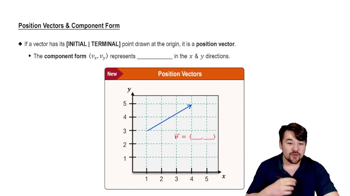
Vector Representation in Component Form

Vectors in two dimensions can be expressed as a combination of unit vectors i and j, representing the x and y components respectively. For example, u = 2i - 5j means the vector has an x-component of 2 and a y-component of -5. Understanding this form allows for straightforward vector addition and scalar multiplication.
Video consigliato:
Percorso guidato
03:55
Position Vectors & Component Form

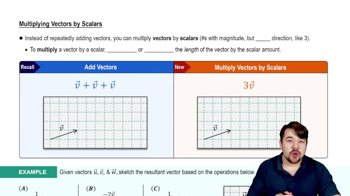
Scalar Multiplication of Vectors

Scalar multiplication involves multiplying each component of a vector by a scalar (a real number). For instance, multiplying vector w by 3 means multiplying both its i and j components by 3, resulting in a new vector scaled in magnitude but with the same direction if the scalar is positive.
Video consigliato:
Percorso guidato
05:05
Multiplying Vectors By Scalars

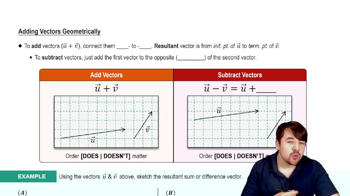
Vector Addition

Vector addition is performed by adding corresponding components of two vectors. For example, adding 2v and 3w requires adding the x-components of 2v and 3w together, and similarly for the y-components, resulting in a new vector that combines both directions and magnitudes.
Video consigliato:
Percorso guidato
05:29
Adding Vectors Geometrically