Ch. 4 - Laws of Sines and Cosines; Vectors
Blitzer - Trigonometry 3rd Edition
Blitzer3rd EditionTrigonometryISBN: 9780137316601Non è quello che usi tu?Cambia libro di testo
Capitolo 4, Problema 38

In Exercises 37–39, find the dot product v ⋅ w. Then find the angle between v and w to the nearest tenth of a degree.
v = 2i + 4j, w = 6i - 11j

Guida verificata passo dopo passo
1
Identify the components of the vectors \( \mathbf{v} = 2\mathbf{i} + 4\mathbf{j} \) and \( \mathbf{w} = 6\mathbf{i} - 11\mathbf{j} \). Here, \( \mathbf{v} = (2, 4) \) and \( \mathbf{w} = (6, -11) \).
Calculate the dot product \( \mathbf{v} \cdot \mathbf{w} \) using the formula \( \mathbf{v} \cdot \mathbf{w} = v_1 w_1 + v_2 w_2 \). Substitute the components to get \( 2 \times 6 + 4 \times (-11) \).
Find the magnitudes of \( \mathbf{v} \) and \( \mathbf{w} \) using the formula \( \|\mathbf{v}\| = \sqrt{v_1^2 + v_2^2} \) and similarly for \( \mathbf{w} \). Calculate \( \|\mathbf{v}\| = \sqrt{2^2 + 4^2} \) and \( \|\mathbf{w}\| = \sqrt{6^2 + (-11)^2} \).
Use the dot product and magnitudes to find the cosine of the angle \( \theta \) between the vectors with the formula \( \cos(\theta) = \frac{\mathbf{v} \cdot \mathbf{w}}{\|\mathbf{v}\| \|\mathbf{w}\|} \).
Finally, find the angle \( \theta \) by taking the inverse cosine (arccos) of the value found in the previous step, and convert the result to degrees if necessary, rounding to the nearest tenth of a degree.

Risposta video verificata per un problema simile:

Questa soluzione video è stata consigliata dai nostri tutor come utile per risolvere questo problema.
Durata del video:
5m

Concetti chiave

Ecco i concetti essenziali che devi comprendere per rispondere correttamente alla domanda.

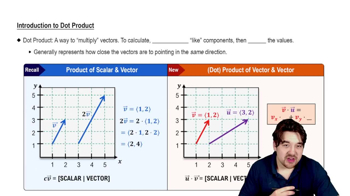
Dot Product of Two Vectors

The dot product is an algebraic operation that takes two vectors and returns a scalar. It is calculated by multiplying corresponding components and summing the results, e.g., for vectors v = (v1, v2) and w = (w1, w2), v ⋅ w = v1w1 + v2w2. This operation measures how much one vector extends in the direction of another.
Video consigliato:
Percorso guidato
05:40
Introduction to Dot Product

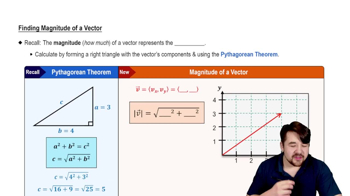
Magnitude of a Vector

The magnitude (or length) of a vector is the distance from the origin to the point represented by the vector. For a vector v = (v1, v2), its magnitude is |v| = √(v1² + v2²). Magnitudes are essential for normalizing vectors and calculating angles between them.
Video consigliato:
Percorso guidato
04:44
Finding Magnitude of a Vector

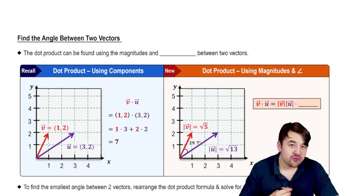
Angle Between Two Vectors

The angle θ between two vectors v and w can be found using the dot product formula: v ⋅ w = |v||w|cos(θ). Rearranging gives θ = cos⁻¹((v ⋅ w) / (|v||w|)). This formula relates the dot product and magnitudes to the cosine of the angle, allowing calculation of the angle in degrees or radians.
Video consigliato:
Percorso guidato
04:33
Find the Angle Between Vectors