In Exercises 45–50, determine whether v and w are parallel, orthogonal, or neither. v = 3i - 5j, w = 6i - 10j
Ch. 4 - Laws of Sines and Cosines; Vectors

Capitolo 4, Problema 44
In Exercises 39–46, find the unit vector that has the same direction as the vector v.
v = 4i - 2j
Guida verificata passo dopo passo1
Identify the given vector \( \mathbf{v} = 4\mathbf{i} - 2\mathbf{j} \). This means the vector has components \( (4, -2) \).
Calculate the magnitude (length) of the vector \( \mathbf{v} \) using the formula:
\[ \|\mathbf{v}\| = \sqrt{(4)^2 + (-2)^2} \]
Simplify the expression under the square root to find the magnitude:
\[ \|\mathbf{v}\| = \sqrt{16 + 4} \]
Find the unit vector \( \mathbf{u} \) in the same direction as \( \mathbf{v} \) by dividing each component of \( \mathbf{v} \) by its magnitude:
\[ \mathbf{u} = \left( \frac{4}{\|\mathbf{v}\|}, \frac{-2}{\|\mathbf{v}\|} \right) \]
Express the unit vector in terms of the standard unit vectors \( \mathbf{i} \) and \( \mathbf{j} \):
\[ \mathbf{u} = \frac{4}{\|\mathbf{v}\|} \mathbf{i} - \frac{2}{\|\mathbf{v}\|} \mathbf{j} \]

Risposta video verificata per un problema simile:
Questa soluzione video è stata consigliata dai nostri tutor come utile per risolvere questo problema.
Durata del video:
2mConcetti chiave
Ecco i concetti essenziali che devi comprendere per rispondere correttamente alla domanda.
Vector Components
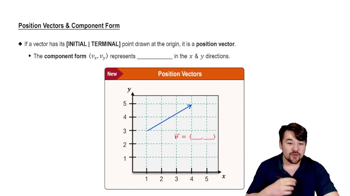
A vector in two dimensions can be expressed in terms of its components along the x and y axes, typically written as v = ai + bj, where a and b are scalar values. Understanding these components is essential for operations like finding magnitude and direction.
Video consigliato:
Percorso guidato
Position Vectors & Component Form
Magnitude of a Vector
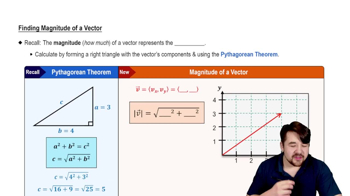
The magnitude (or length) of a vector v = ai + bj is calculated using the Pythagorean theorem as √(a² + b²). This scalar value represents the distance from the origin to the point defined by the vector components.
Video consigliato:
Percorso guidato
Finding Magnitude of a Vector
Unit Vector
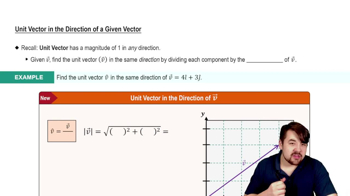
A unit vector has a magnitude of 1 and points in the same direction as the original vector. It is found by dividing each component of the vector by its magnitude, effectively normalizing the vector without changing its direction.
Video consigliato:
Percorso guidato
Unit Vector in the Direction of a Given Vector
Pratica correlata
Domanda del libro di testo
754
views
Domanda del libro di testo
In Exercises 39–46, find the unit vector that has the same direction as the vector v.
v = 3i - 2j
1227
views
Domanda del libro di testo
In Exercises 39–46, find the unit vector that has the same direction as the vector v. v = i + j
989
views
Domanda del libro di testo
In Exercises 43–44, find the angle, in degrees, between v and w.
v = 2 cos(4π/3) i + 2 sin(4π/3) j, w = 3 cos(3π/2) i + 3 sin(3π/2) j
772
views
Domanda del libro di testo
In Exercises 42–43, find projᵥᵥv. Then decompose v into two vectors, v₁ and v₂ where v₁ is parallel to w and v₂ is orthogonal to w.
v = -2i + 5j, w = 5i + 4j
717
views
Domanda del libro di testo
In Exercises 43–44, use the given measurements to solve the following triangle. Round lengths of sides to the nearest tenth and angle measures to the nearest degree. a = 400, b = 300
1098
views