Ch. 4 - Laws of Sines and Cosines; Vectors
Blitzer - Trigonometry 3rd Edition
Blitzer3rd EditionTrigonometryISBN: 9780137316601Non è quello che usi tu?Cambia libro di testo
Capitolo 4, Problema 47

In Exercises 45–50, determine whether v and w are parallel, orthogonal, or neither. v = 3i - 5j, w = 6i + 10j

Guida verificata passo dopo passo
1
Identify the vectors \( \mathbf{v} = 3\mathbf{i} - 5\mathbf{j} \) and \( \mathbf{w} = 6\mathbf{i} + 10\mathbf{j} \). Write them in component form as \( \mathbf{v} = (3, -5) \) and \( \mathbf{w} = (6, 10) \).
To check if the vectors are parallel, see if one is a scalar multiple of the other. This means checking if there exists a scalar \( k \) such that \( (6, 10) = k(3, -5) \).
To check if the vectors are orthogonal (perpendicular), calculate their dot product. The dot product formula is \( \mathbf{v} \cdot \mathbf{w} = v_1 w_1 + v_2 w_2 \). Substitute the components to get \( 3 \times 6 + (-5) \times 10 \).
Evaluate the dot product expression to determine if it equals zero. If the dot product is zero, the vectors are orthogonal.
Based on the results from the scalar multiple check and the dot product, conclude whether \( \mathbf{v} \) and \( \mathbf{w} \) are parallel, orthogonal, or neither.

Risposta video verificata per un problema simile:

Questa soluzione video è stata consigliata dai nostri tutor come utile per risolvere questo problema.
Durata del video:
5m

Concetti chiave

Ecco i concetti essenziali che devi comprendere per rispondere correttamente alla domanda.

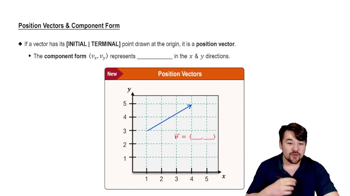
Vector Representation in Component Form

Vectors can be expressed in terms of their components along the coordinate axes, such as v = 3i - 5j, where 3 and -5 are the components along the x and y axes respectively. Understanding this form allows for algebraic operations like addition, scalar multiplication, and dot product calculation.
Video consigliato:
Percorso guidato
03:55
Position Vectors & Component Form

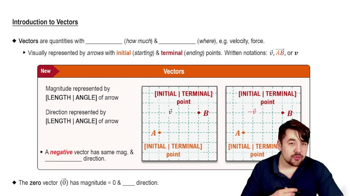
Parallel Vectors

Two vectors are parallel if one is a scalar multiple of the other, meaning their components are proportional. For example, if v = k * w for some scalar k, then v and w point in the same or opposite direction, indicating parallelism.
Video consigliato:
Percorso guidato
03:48
Introduction to Vectors

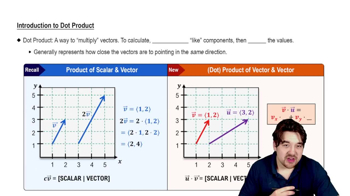
Orthogonal Vectors and the Dot Product

Vectors are orthogonal (perpendicular) if their dot product equals zero. The dot product is calculated by multiplying corresponding components and summing the results. If v · w = 0, the vectors form a 90-degree angle.
Video consigliato:
Percorso guidato
05:40
Introduction to Dot Product