In Exercises 9–16, solve each triangle. Round lengths to the nearest tenth and angle measures to the nearest degree.
A = 56°, C = 24°, a = 22
Guida verificata passo dopo passo
1
insert step 1
insert step 2
insert step 3
insert step 4
insert step 5
Risposta video verificata per un problema simile:
Questa soluzione video è stata consigliata dai nostri tutor come utile per risolvere questo problema.
Durata del video:
6m
Guarda un video:
0 Commenti
Concetti chiave
Ecco i concetti essenziali che devi comprendere per rispondere correttamente alla domanda.
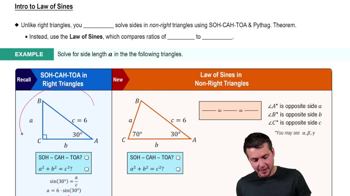
Law of Sines
The Law of Sines is a fundamental principle in trigonometry that relates the ratios of the lengths of sides of a triangle to the sines of its angles. It states that for any triangle, the ratio of a side length to the sine of its opposite angle is constant. This law is particularly useful for solving triangles when given two angles and one side (AAS or ASA) or two sides and a non-included angle (SSA).
The Triangle Sum Theorem states that the sum of the interior angles of a triangle is always 180 degrees. This theorem is essential for finding unknown angles in a triangle when two angles are known. In the given problem, knowing angle A and angle C allows us to calculate angle B, which is crucial for applying the Law of Sines effectively.
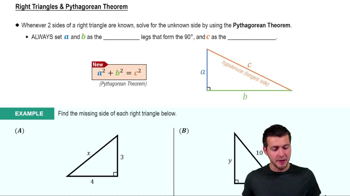
Solving Right Triangles with the Pythagorean Theorem
Rounding Rules
Rounding rules are guidelines for approximating numbers to a specified degree of accuracy. In this context, lengths are rounded to the nearest tenth and angle measures to the nearest degree. Understanding how to round correctly is important for presenting final answers in a clear and standardized format, ensuring that results are both accurate and easy to interpret.


 Guida verificata passo dopo passo
 4:27
4:27