Ch. 4 - Laws of Sines and Cosines; Vectors
Blitzer - Trigonometry 3rd Edition
Blitzer3rd EditionTrigonometryISBN: 9780137316601Non è quello che usi tu?Cambia libro di testo
Capitolo 4, Problema 23

In Exercises 9–24, solve each triangle. Round lengths to the nearest tenth and angle measures to the nearest degree.
a = 63, b = 22, c = 50

Guida verificata passo dopo passo
1
Identify the given elements of the triangle: sides \(a = 63\), \(b = 22\), and \(c = 50\). Since all three sides are known, this is a Side-Side-Side (SSS) case.
Use the Law of Cosines to find one of the angles. For example, to find angle \(A\) opposite side \(a\), use the formula: \[\cos(A) = \frac{b^2 + c^2 - a^2}{2bc}\]
Calculate \(\cos(A)\) by substituting the known side lengths into the formula, then find angle \(A\) by taking the inverse cosine (arccos) of that value: \[A = \cos^{-1}\left(\frac{b^2 + c^2 - a^2}{2bc}\right)\]
Once angle \(A\) is found, use the Law of Cosines again to find another angle, for example angle \(B\) opposite side \(b\): \[\cos(B) = \frac{a^2 + c^2 - b^2}{2ac}\] Then find \(B\) by taking the inverse cosine.
Finally, find the third angle \(C\) using the fact that the sum of angles in a triangle is \(180^\circ\): \[C = 180^\circ - A - B\] Round all angles to the nearest degree and all sides are already given.

Risposta video verificata per un problema simile:

Questa soluzione video è stata consigliata dai nostri tutor come utile per risolvere questo problema.
Durata del video:
8m

Concetti chiave

Ecco i concetti essenziali che devi comprendere per rispondere correttamente alla domanda.

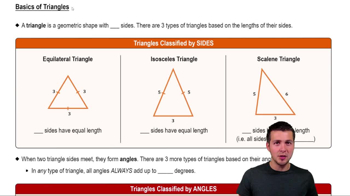
Triangle Classification and Properties

Understanding the types of triangles (scalene, isosceles, equilateral) and their properties is essential. Given three sides, the triangle inequality theorem must be checked to ensure a valid triangle exists before solving for angles.
Video consigliato:
Percorso guidato
4:42
Review of Triangles

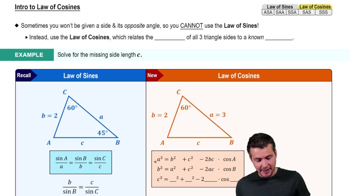
Law of Cosines

The Law of Cosines relates the lengths of sides of a triangle to the cosine of one of its angles. It is used to find unknown angles when all three sides are known, using the formula: c² = a² + b² - 2ab cos(C).
Video consigliato:
Percorso guidato
4:35
Intro to Law of Cosines

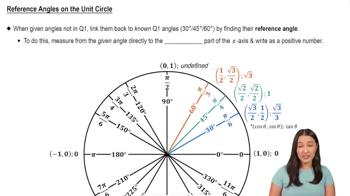
Rounding and Angle Measurement

After calculating side lengths and angles, results must be rounded appropriately. Lengths are rounded to the nearest tenth, and angles to the nearest degree, ensuring answers are precise and practical for real-world applications.
Video consigliato:
Percorso guidato
5:31
Reference Angles on the Unit Circle