In Exercises 1–4, u and v have the same direction. In each exercise: Is u = v? Explain.
Ch. 4 - Laws of Sines and Cosines; Vectors

Capitolo 4, Problema 2
In oblique triangle ABC, C = 68°, a = 5, and b = 6. Find c to the nearest tenth.
Guida verificata passo dopo passo1
Identify the given elements in triangle ABC: angle C = 68°, side a = 5 (opposite angle A), and side b = 6 (opposite angle B). We need to find side c (opposite angle C).
Use the Law of Cosines formula to find side c, which relates the sides and the included angle: \(c^2 = a^2 + b^2 - 2ab \cdot \cos(C)\).
Substitute the known values into the Law of Cosines formula: \(c^2 = 5^2 + 6^2 - 2 \times 5 \times 6 \times \cos(68^\circ)\).
Calculate the right-hand side expression step-by-step: square the sides, multiply the terms, and find the cosine of 68° (using a calculator or trigonometric table).
Take the square root of the result to find side c: \(c = \sqrt{\text{calculated value}}\). Round the answer to the nearest tenth as requested.

Risposta video verificata per un problema simile:
Questa soluzione video è stata consigliata dai nostri tutor come utile per risolvere questo problema.
Durata del video:
3mConcetti chiave
Ecco i concetti essenziali che devi comprendere per rispondere correttamente alla domanda.
Law of Cosines
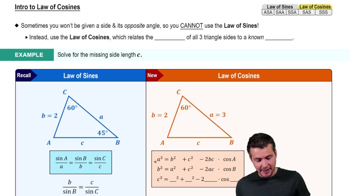
The Law of Cosines relates the lengths of sides of any triangle to the cosine of one of its angles. It is especially useful in oblique triangles where no right angle is present. The formula is c² = a² + b² - 2ab cos(C), allowing calculation of the unknown side when two sides and the included angle are known.
Video consigliato:
Percorso guidato
Intro to Law of Cosines
Oblique Triangle
An oblique triangle is any triangle that does not contain a right angle. Solving oblique triangles often requires the Law of Sines or Law of Cosines, as the Pythagorean theorem does not apply. Understanding the classification helps determine the appropriate method for finding unknown sides or angles.
Video consigliato:
Percorso guidato
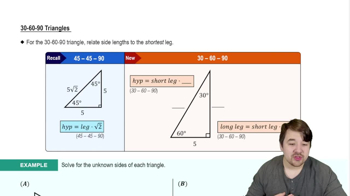
30-60-90 Triangles
Angle-Side Relationship
In any triangle, the side lengths and angles are interdependent; knowing two sides and the included angle allows calculation of the third side. This relationship is fundamental in applying the Law of Cosines, ensuring the correct angle is used between the given sides to find the unknown side length.
Video consigliato:
Percorso guidato
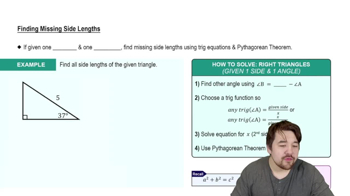
Finding Missing Side Lengths
Pratica correlata
Domanda del libro di testo
874
views
Domanda del libro di testo
In Exercises 1–8, solve each triangle. Round lengths of sides to the nearest tenth and angle measures to the nearest degree.
443
views
Domanda del libro di testo
In Exercises 1–12, solve each triangle. Round lengths to the nearest tenth and angle measures to the nearest degree. If no triangle exists, state 'no triangle.' If two triangles exist, solve each triangle. B = 66°, a = 17, c = 12
677
views
Domanda del libro di testo
In Exercises 1–4, u and v have the same direction. In each exercise: Find ||v||.
706
views
Domanda del libro di testo
In Exercises 1–12, solve each triangle. Round lengths to the nearest tenth and angle measures to the nearest degree. If no triangle exists, state 'no triangle.' If two triangles exist, solve each triangle. B = 107°, C = 30°, c = 126
606
views
Domanda del libro di testo
In Exercises 1–4, u and v have the same direction. In each exercise: Find ||u||.
963
views