Ch. 5 - Complex Numbers, Polar Coordinates and Parametric Equations
Blitzer - Trigonometry 3rd Edition
Blitzer3rd EditionTrigonometryISBN: 9780137316601Non è quello che usi tu?Cambia libro di testo
Capitolo 5, Problema 5

In Exercises 1–10, indicate if the point with the given polar coordinates is represented by A, B, C, or D on the graph. (3, π)

Guida verificata passo dopo passo
1
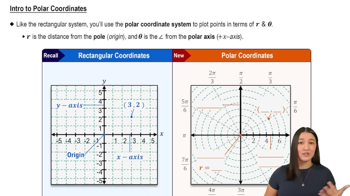
Recall that polar coordinates are given in the form \((r, \theta)\), where \(r\) is the distance from the origin and \(\theta\) is the angle measured from the positive x-axis (polar axis) in radians.
Identify the given polar coordinates: here, \(r = 3\) and \(\theta = \pi\) radians. This means the point is 3 units away from the origin, along the direction of the angle \(\pi\).
Understand that \(\pi\) radians corresponds to an angle of 180 degrees, which points directly to the left along the negative x-axis.
To locate the point on the graph, start at the origin, move along the angle \(\pi\) (to the left), and measure a distance of 3 units from the origin in that direction.
Compare this position with the points labeled A, B, C, and D on the graph to determine which one matches the coordinates \((3, \pi)\).

Risposta video verificata per un problema simile:

Questa soluzione video è stata consigliata dai nostri tutor come utile per risolvere questo problema.
Durata del video:
2m

Concetti chiave

Ecco i concetti essenziali che devi comprendere per rispondere correttamente alla domanda.

Polar Coordinates System

The polar coordinate system represents points using a distance from the origin (radius r) and an angle θ measured from the positive x-axis. Each point is given as (r, θ), where r ≥ 0 and θ is typically in radians. Understanding how to interpret these coordinates is essential for locating points on a polar graph.
Video consigliato:
Percorso guidato
05:32
Intro to Polar Coordinates

Conversion Between Polar and Cartesian Coordinates

To plot or identify points on a graph, it is often helpful to convert polar coordinates (r, θ) into Cartesian coordinates (x, y) using x = r cos θ and y = r sin θ. This conversion allows for easier comparison with points labeled on a Cartesian plane or graph.
Video consigliato:
Percorso guidato
05:32
Intro to Polar Coordinates

Angle Measurement and Direction in Polar Coordinates

Angles in polar coordinates are measured counterclockwise from the positive x-axis. Knowing how to interpret the angle θ, especially when it equals π (180 degrees), helps determine the direction of the point from the origin, which is crucial for correctly identifying the point on the graph.
Video consigliato:
Percorso guidato
05:32
Intro to Polar Coordinates