In Exercises 25–29, use DeMoivre's Theorem to find the indicated power of the complex number. Write answers in rectangular form. (−2 − 2i)⁵
Ch. 5 - Complex Numbers, Polar Coordinates and Parametric Equations

Tutti i libri di testo
Blitzer 3rd Edition
Ch. 5 - Complex Numbers, Polar Coordinates and Parametric Equations
Problema 27
Blitzer 3rd Edition
Ch. 5 - Complex Numbers, Polar Coordinates and Parametric Equations
Problema 27Capitolo 5, Problema 27
In Exercises 21–40, eliminate the parameter t. Then use the rectangular equation to sketch the plane curve represented by the given parametric equations. Use arrows to show the orientation of the curve corresponding to increasing values of t. (If an interval for t is not specified, assume that −∞ < t < ∞.
x = 2 sin t, y = 2 cos t; 0 ≤ t < 2π
Guida verificata passo dopo passo1
Identify the given parametric equations: \(x = 2 \sin t\) and \(y = 2 \cos t\), with the parameter \(t\) in the interval \(0 \leq t < 2\pi\).
Recall the Pythagorean identity: \(\sin^2 t + \cos^2 t = 1\). This identity will help us eliminate the parameter \(t\) by expressing \(\sin t\) and \(\cos t\) in terms of \(x\) and \(y\).
Express \(\sin t\) and \(\cos t\) from the parametric equations: \(\sin t = \frac{x}{2}\) and \(\cos t = \frac{y}{2}\).
Substitute these expressions into the Pythagorean identity to get the rectangular equation: \(\left(\frac{x}{2}\right)^2 + \left(\frac{y}{2}\right)^2 = 1\).
Simplify the equation to the standard form of a circle: \(\frac{x^2}{4} + \frac{y^2}{4} = 1\). This represents a circle centered at the origin with radius 2. To sketch the curve, draw this circle and use the parameter interval to determine the orientation, noting that as \(t\) increases from \(0\) to \(2\pi\), the point moves clockwise because \(x = 2 \sin t\) and \(y = 2 \cos t\).

Risposta video verificata per un problema simile:
Questa soluzione video è stata consigliata dai nostri tutor come utile per risolvere questo problema.
Durata del video:
7mConcetti chiave
Ecco i concetti essenziali che devi comprendere per rispondere correttamente alla domanda.
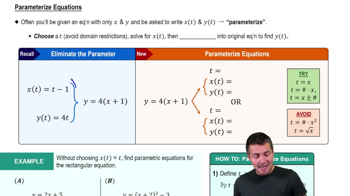
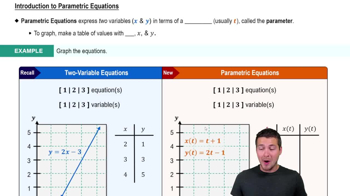
Parametric Equations
Parametric equations express the coordinates of points on a curve as functions of a parameter, often denoted as t. Instead of y as a function of x, both x and y depend on t, allowing the description of more complex curves and motions. Understanding how to manipulate these equations is key to analyzing the curve's shape and behavior.
Video consigliato:
Percorso guidato
Parameterizing Equations
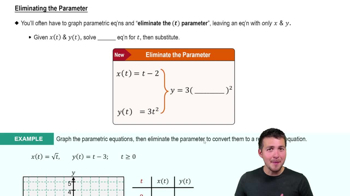
Eliminating the Parameter
Eliminating the parameter involves rewriting the parametric equations to form a single equation in x and y, removing t. This is done by expressing t from one equation and substituting into the other or using trigonometric identities. This step converts the parametric form into a rectangular (Cartesian) equation, simplifying graphing and analysis.
Video consigliato:
Percorso guidato
Eliminating the Parameter
Orientation and Sketching of Parametric Curves
Orientation refers to the direction in which the curve is traced as the parameter t increases. When sketching, arrows indicate this direction, helping to understand the curve's dynamic behavior. Recognizing the interval of t and how x and y change with t is essential for accurate graphing and interpretation.
Video consigliato:
Percorso guidato
Introduction to Parametric Equations
Pratica correlata
Domanda del libro di testo
570
views
Domanda del libro di testo
In Exercises 27–32, select the representations that do not change the location of the given point. (7, 140°) (−7, 320°)
664
views
Domanda del libro di testo
In Exercises 27–32, select the representations that do not change the location of the given point. (4, 120°) (−4, 300°)
735
views
Domanda del libro di testo
In Exercises 25–29, use DeMoivre's Theorem to find the indicated power of the complex number. Write answers in rectangular form. [1/2 (cos π/14 + i sin π/14)]⁷
640
views
Domanda del libro di testo
In Exercises 25–29, use DeMoivre's Theorem to find the indicated power of the complex number. Write answers in rectangular form. _ (1−i√3)²
593
views
Domanda del libro di testo
In Exercises 27–36, write each complex number in rectangular form. If necessary, round to the nearest tenth. 6(cos 30° + i sin 30°)
525
views