Ch. 5 - Complex Numbers, Polar Coordinates and Parametric Equations
Blitzer - Trigonometry 3rd Edition
Blitzer3rd EditionTrigonometryISBN: 9780137316601Non è quello che usi tu?Cambia libro di testo
Capitolo 5, Problema 29

In Exercises 27–32, select the representations that do not change the location of the given point. (2, − 3π/4) (2, − 7π/4)

Guida verificata passo dopo passo
1
Understand that the problem involves identifying different representations of points in polar coordinates that correspond to the same location. The point is given in the form \((r, \theta)\), where \(r\) is the radius (distance from the origin) and \(\theta\) is the angle measured in radians.
Recall that in polar coordinates, the same point can be represented by adding or subtracting full rotations of \(2\pi\) to the angle \(\theta\). This means that \(\theta\) and \(\theta + 2k\pi\) (where \(k\) is any integer) represent the same direction.
Also remember that changing the sign of \(r\) and adding \(\pi\) to the angle gives the same point: \((r, \theta)\) is equivalent to \((-r, \theta + \pi)\). This is because moving in the opposite direction by \(\pi\) radians with a negative radius points to the same location.
For the point \((2, -\frac{3\pi}{4})\), check if the alternative representations add or subtract multiples of \(2\pi\) to the angle or use the negative radius rule to see if the location remains unchanged.
Similarly, for the point \((2, -\frac{7\pi}{4})\), apply the same checks: add or subtract \(2\pi\) multiples to the angle or use the negative radius and angle shift to find equivalent points that do not change the location.

Risposta video verificata per un problema simile:

Questa soluzione video è stata consigliata dai nostri tutor come utile per risolvere questo problema.

Concetti chiave

Ecco i concetti essenziali che devi comprendere per rispondere correttamente alla domanda.

Polar Coordinates and Point Representation

Polar coordinates represent points using a radius and an angle, written as (r, θ). The radius r is the distance from the origin, and θ is the angle measured from the positive x-axis. Understanding how points are plotted in this system is essential to analyze changes in location.
Video consigliato:
Percorso guidato
06:17
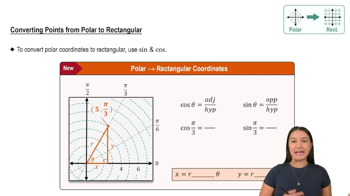
Convert Points from Polar to Rectangular

Angle Coterminality in Polar Coordinates

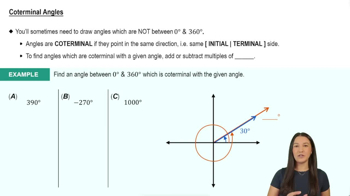
Angles that differ by multiples of 2π radians are coterminal, meaning they point in the same direction on the polar plane. Recognizing coterminal angles helps identify when different angle measures represent the same point location.
Video consigliato:
Percorso guidato
04:46
Coterminal Angles

Effect of Negative Radius and Angle Adjustments

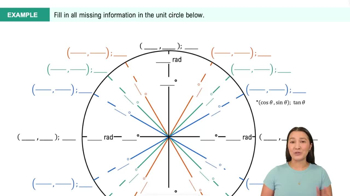
In polar coordinates, a negative radius reverses the direction of the point by π radians, effectively changing its location unless the angle is adjusted accordingly. Understanding how changing the sign of r or modifying θ affects the point's position is crucial for determining if the location remains unchanged.
Video consigliato: