Ch. 5 - Complex Numbers, Polar Coordinates and Parametric Equations
Blitzer - Trigonometry 3rd Edition
Blitzer3rd EditionTrigonometryISBN: 9780137316601Non è quello che usi tu?Cambia libro di testo
Capitolo 5, Problema 31

In Exercises 30–31, find all the complex roots. Write roots in polar form with θ in degrees. The complex cube roots of 125(cos 165° + i sin 165°)

Guida verificata passo dopo passo
1
Identify the given complex number in polar form: \(125(\cos 165^\circ + i \sin 165^\circ)\), where the modulus \(r = 125\) and the argument \(\theta = 165^\circ\).
Recall that to find the cube roots of a complex number in polar form \(r(\cos \theta + i \sin \theta)\), the roots are given by: \(\sqrt[3]{r} \left( \cos \left( \frac{\theta + 360^\circ k}{3} \right) + i \sin \left( \frac{\theta + 360^\circ k}{3} \right) \right)\), where \(k = 0, 1, 2\).
Calculate the cube root of the modulus: \(\sqrt[3]{125}\), which will be the modulus of each root.
For each integer \(k = 0, 1, 2\), compute the argument of each root by evaluating \(\frac{165^\circ + 360^\circ k}{3}\).
Write each root in polar form as \(r_k (\cos \theta_k + i \sin \theta_k)\) using the modulus from step 3 and the arguments from step 4.

Risposta video verificata per un problema simile:

Questa soluzione video è stata consigliata dai nostri tutor come utile per risolvere questo problema.
Durata del video:
7m

Concetti chiave

Ecco i concetti essenziali che devi comprendere per rispondere correttamente alla domanda.

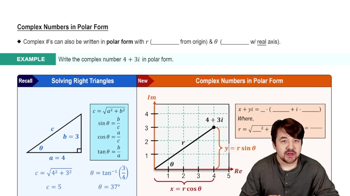
Complex Numbers in Polar Form

Complex numbers can be expressed in polar form as r(cos θ + i sin θ), where r is the magnitude and θ is the argument (angle). This form simplifies multiplication, division, and finding roots by working with magnitudes and angles separately.
Video consigliato:
Percorso guidato
04:47
Complex Numbers In Polar Form

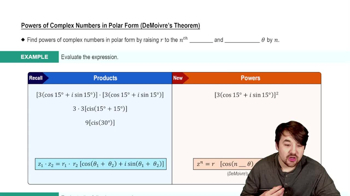
De Moivre's Theorem

De Moivre's theorem states that for a complex number in polar form, raising it to the power n results in r^n (cos nθ + i sin nθ). Conversely, the nth roots can be found by taking the nth root of the magnitude and dividing the angle by n, adding multiples of 360°/n for all roots.
Video consigliato:
Percorso guidato
03:41
Powers Of Complex Numbers In Polar Form (DeMoivre's Theorem)

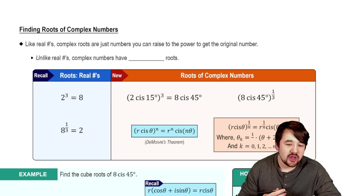
Finding Complex Roots

To find the nth roots of a complex number, calculate the nth root of the magnitude and determine the arguments by dividing the original angle by n and adding k(360°/n) for k = 0, 1, ..., n-1. This yields all distinct roots evenly spaced around the circle.
Video consigliato: