In Exercises 53–64, use DeMoivre's Theorem to find the indicated power of the complex number. Write answers in rectangular form. [4(cos 15° + i sin 15°)]³
Ch. 5 - Complex Numbers, Polar Coordinates and Parametric Equations

Tutti i libri di testo
Blitzer 3rd Edition
Ch. 5 - Complex Numbers, Polar Coordinates and Parametric Equations
Problema 5.2.64
Blitzer 3rd Edition
Ch. 5 - Complex Numbers, Polar Coordinates and Parametric Equations
Problema 5.2.64Capitolo 5, Problema 5.2.64
In Exercises 53–64, use DeMoivre's Theorem to find the indicated power of the complex number. Write answers in rectangular form. (√2 − i)⁴
Guida verificata passo dopo passo1
Express the complex number \( \sqrt{2} - i \) in polar form. To do this, find the modulus \( r \) using \( r = \sqrt{(\sqrt{2})^2 + (-1)^2} \) and the argument \( \theta \) using \( \theta = \tan^{-1} \left( \frac{-1}{\sqrt{2}} \right) \).
Write the complex number in polar form as \( r (\cos \theta + i \sin \theta) \).
Apply DeMoivre's Theorem to raise the complex number to the 4th power: \( (r (\cos \theta + i \sin \theta))^4 = r^4 (\cos 4\theta + i \sin 4\theta) \).
Calculate \( r^4 \) and multiply the argument \( \theta \) by 4 to find \( 4\theta \).
Convert the result back to rectangular form by evaluating \( r^4 \cos 4\theta \) for the real part and \( r^4 \sin 4\theta \) for the imaginary part, giving the final answer in the form \( a + bi \).

Risposta video verificata per un problema simile:
Questa soluzione video è stata consigliata dai nostri tutor come utile per risolvere questo problema.
Durata del video:
10mConcetti chiave
Ecco i concetti essenziali che devi comprendere per rispondere correttamente alla domanda.
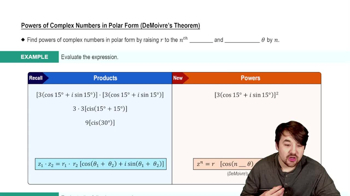
DeMoivre's Theorem
DeMoivre's Theorem states that for a complex number expressed in polar form as r(cos θ + i sin θ), its nth power is r^n (cos nθ + i sin nθ). This theorem simplifies raising complex numbers to powers by working with their magnitude and angle instead of expanding binomials.
Video consigliato:
Percorso guidato
Powers Of Complex Numbers In Polar Form (DeMoivre's Theorem)
Conversion Between Rectangular and Polar Forms
Complex numbers can be represented in rectangular form (a + bi) or polar form (r(cos θ + i sin θ)). Converting involves finding the magnitude r = √(a² + b²) and the argument θ = arctan(b/a). This conversion is essential for applying DeMoivre's Theorem effectively.
Video consigliato:
Percorso guidato
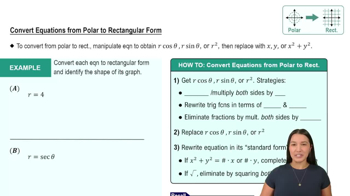
Convert Equations from Polar to Rectangular
Rectangular Form of Complex Numbers
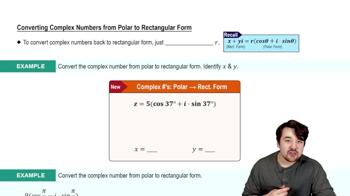
Rectangular form expresses complex numbers as a + bi, where a is the real part and b is the imaginary part. After using DeMoivre's Theorem in polar form, the result is converted back to rectangular form by evaluating r^n cos nθ and r^n sin nθ to find the real and imaginary components.
Video consigliato:
Percorso guidato
Converting Complex Numbers from Polar to Rectangular Form
Pratica correlata
Domanda del libro di testo
548
views
Domanda del libro di testo
In Exercises 49–58, convert each rectangular equation to a polar equation that expresses r in terms of θ. x = 7
846
views
Domanda del libro di testo
In Exercises 53–56, find two different sets of parametric equations for each rectangular equation. y = 4x − 3
731
views
Domanda del libro di testo
In Exercises 49–58, convert each rectangular equation to a polar equation that expresses r in terms of θ.
y² = 6x
359
views
Domanda del libro di testo
In Exercises 53–58, perform the indicated operation(s) and write the result in standard form. (2 − 3i)(1 − i) − (3 − i)(3 + i)
704
views
Domanda del libro di testo
In Exercises 53–64, use DeMoivre's Theorem to find the indicated power of the complex number. Write answers in rectangular form. [√2 (cos (5π/6) + i sin (5π/6))]⁴
567
views