Ch. 5 - Complex Numbers, Polar Coordinates and Parametric Equations
Blitzer - Trigonometry 3rd Edition
Blitzer3rd EditionTrigonometryISBN: 9780137316601Non è quello che usi tu?Cambia libro di testo
Capitolo 5, Problema 5.2.55

In Exercises 53–64, use DeMoivre's Theorem to find the indicated power of the complex number. Write answers in rectangular form. [2(cos 80° + i sin 80°)]³

Guida verificata passo dopo passo
1
Identify the complex number in polar form: \(2(\cos 80^\circ + i \sin 80^\circ)\), where the modulus \(r = 2\) and the argument \(\theta = 80^\circ\).
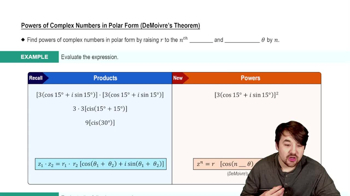
Recall DeMoivre's Theorem, which states that for a complex number in polar form \(r(\cos \theta + i \sin \theta)\), its \(n\)th power is given by \(r^n (\cos n\theta + i \sin n\theta)\).
Apply DeMoivre's Theorem with \(n = 3\): compute the new modulus as \(r^3 = 2^3\) and the new argument as \(3 \times 80^\circ\).
Write the resulting complex number in polar form: \(2^3 (\cos 240^\circ + i \sin 240^\circ)\).
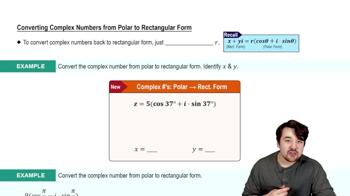
Convert the polar form back to rectangular form using \(x = r^3 \cos 240^\circ\) and \(y = r^3 \sin 240^\circ\), so the rectangular form is $x + iy$.

Risposta video verificata per un problema simile:

Questa soluzione video è stata consigliata dai nostri tutor come utile per risolvere questo problema.
Durata del video:
5m

Concetti chiave

Ecco i concetti essenziali che devi comprendere per rispondere correttamente alla domanda.

DeMoivre's Theorem

DeMoivre's Theorem states that for a complex number in polar form, (r(cos θ + i sin θ))^n = r^n (cos nθ + i sin nθ). It allows raising complex numbers to integer powers by multiplying the angle and raising the magnitude to the power.
Video consigliato:
Percorso guidato
03:41
Powers Of Complex Numbers In Polar Form (DeMoivre's Theorem)

Polar and Rectangular Forms of Complex Numbers

Complex numbers can be expressed in polar form as r(cos θ + i sin θ), where r is the magnitude and θ the argument. Rectangular form is a + bi, where a and b are real numbers. Converting between these forms involves trigonometric functions.
Video consigliato:
Percorso guidato
03:58
Converting Complex Numbers from Polar to Rectangular Form

Conversion from Polar to Rectangular Form

To convert a complex number from polar to rectangular form, use a = r cos θ and b = r sin θ. This step is essential after applying DeMoivre's Theorem to express the result as a + bi, which is the standard rectangular form.
Video consigliato:
Percorso guidato
03:58
Converting Complex Numbers from Polar to Rectangular Form