Ch. 5 - Complex Numbers, Polar Coordinates and Parametric Equations
Blitzer - Trigonometry 3rd Edition
Blitzer3rd EditionTrigonometryISBN: 9780137316601Non è quello che usi tu?Cambia libro di testo
Capitolo 5, Problema 5.5.61

In Exercises 59–62, sketch the plane curve represented by the given parametric equations. Then use interval notation to give each relation's domain and range. x = t² + t + 1, y = 2t

Guida verificata passo dopo passo
1
Identify the parametric equations given: \(x = t^{2} + t + 1\) and \(y = 2t\). These describe the coordinates \((x, y)\) in terms of the parameter \(t\).
To sketch the curve, first consider the domain of \(t\). Since \(t\) is a real number parameter, its domain is \((-\infty, \infty)\).
Express \(t\) in terms of \(y\) from the second equation: \(y = 2t \implies t = \frac{y}{2}\). This substitution will help us find the relation between \(x\) and \(y\).
Substitute \(t = \frac{y}{2}\) into the equation for \(x\): \(x = \left(\frac{y}{2}\right)^{2} + \frac{y}{2} + 1 = \frac{y^{2}}{4} + \frac{y}{2} + 1\). This gives the Cartesian form of the curve.
Analyze the domain and range of \(x\) and \(y\): since \(t\) ranges over all real numbers, \(y = 2t\) also ranges over \((-\infty, \infty)\). For \(x\), because it is a quadratic expression in \(t\), determine its minimum value by completing the square or using vertex formula to find the range of \(x\).

Risposta video verificata per un problema simile:

Questa soluzione video è stata consigliata dai nostri tutor come utile per risolvere questo problema.
Durata del video:
6m

Concetti chiave

Ecco i concetti essenziali che devi comprendere per rispondere correttamente alla domanda.

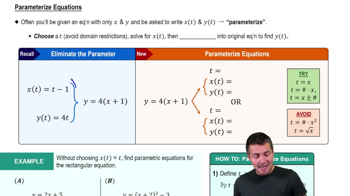
Parametric Equations

Parametric equations express the coordinates of points on a curve as functions of a parameter, often denoted as t. Instead of y as a function of x, both x and y depend on t, allowing the representation of more complex curves and motions.
Video consigliato:
Percorso guidato
08:02
Parameterizing Equations

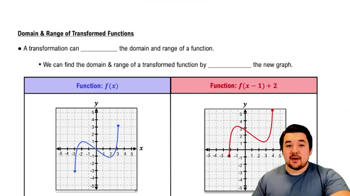
Domain and Range in Parametric Form

The domain refers to all possible values of the parameter t for which the parametric equations are defined. The range consists of all possible output values of x and y generated by those t values. Interval notation is used to express these sets clearly.
Video consigliato:
Percorso guidato
4:22
Domain and Range of Function Transformations

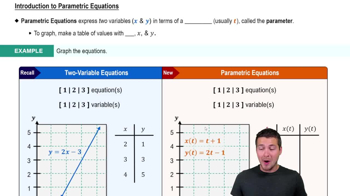
Sketching Parametric Curves

To sketch a parametric curve, calculate points by substituting values of t into the equations, then plot the corresponding (x, y) points. Understanding how x and y change with t helps visualize the shape and direction of the curve.
Video consigliato:
Percorso guidato
04:47
Introduction to Parametric Equations