Ch. 5 - Complex Numbers, Polar Coordinates and Parametric Equations
Blitzer - Trigonometry 3rd Edition
Blitzer3rd EditionTrigonometryISBN: 9780137316601Non è quello che usi tu?Cambia libro di testo
Capitolo 5, Problema 75

In Exercises 69–76, find all the complex roots. Write roots in rectangular form. If necessary, round to the nearest tenth. The complex sixth roots of 1 + i

Guida verificata passo dopo passo
1
Express the complex number \(1 + i\) in polar (trigonometric) form. To do this, find the modulus \(r\) and the argument \(\theta\) where \(r = \sqrt{1^2 + 1^2}\) and \(\theta = \arctan\left(\frac{1}{1}\right)\).
Write \(1 + i\) as \(r(\cos \theta + i \sin \theta)\) using the modulus and argument found in step 1.
Use De Moivre's Theorem to find the sixth roots. The formula for the \(n\)th roots of a complex number is given by: \(z_k = r^{1/n} \left( \cos \left( \frac{\theta + 2\pi k}{n} \right) + i \sin \left( \frac{\theta + 2\pi k}{n} \right) \right)\), where \(k = 0, 1, 2, ..., n-1\). Here, \(n=6\).
Calculate each root by substituting \(k = 0, 1, 2, 3, 4, 5\) into the formula from step 3. This will give you six roots in polar form.
Convert each root from polar form back to rectangular form using \(x = r^{1/n} \cos \left( \frac{\theta + 2\pi k}{n} \right)\) and \(y = r^{1/n} \sin \left( \frac{\theta + 2\pi k}{n} \right)\). Round the real and imaginary parts to the nearest tenth if necessary.

Risposta video verificata per un problema simile:

Questa soluzione video è stata consigliata dai nostri tutor come utile per risolvere questo problema.
Durata del video:
10m

Concetti chiave

Ecco i concetti essenziali che devi comprendere per rispondere correttamente alla domanda.

Complex Numbers in Rectangular and Polar Form

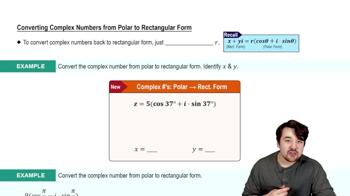
Complex numbers can be expressed in rectangular form as a + bi, where a and b are real numbers, and i is the imaginary unit. They can also be represented in polar form as r(cos θ + i sin θ), where r is the magnitude and θ is the argument (angle). Converting between these forms is essential for finding roots.
Video consigliato:
Percorso guidato
03:58
Converting Complex Numbers from Polar to Rectangular Form

De Moivre's Theorem

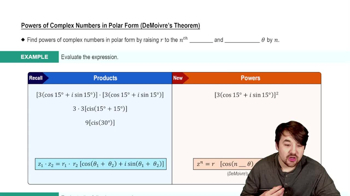
De Moivre's theorem states that for a complex number in polar form, raising it to the nth power corresponds to raising the magnitude to the nth power and multiplying the angle by n. Conversely, the nth roots of a complex number are found by taking the nth root of the magnitude and dividing the angle by n, adding multiples of 2π/n for all roots.
Video consigliato:
Percorso guidato
03:41
Powers Of Complex Numbers In Polar Form (DeMoivre's Theorem)

Finding nth Roots of Complex Numbers

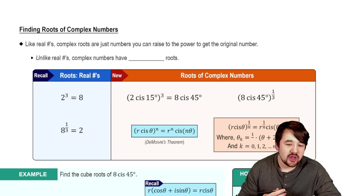
To find the nth roots of a complex number, convert it to polar form, then compute the nth root of the magnitude and find all possible arguments by dividing the original angle by n and adding 2πk/n for k = 0, 1, ..., n-1. Finally, convert each root back to rectangular form for the answer.
Video consigliato: