Domanda del libro di testo
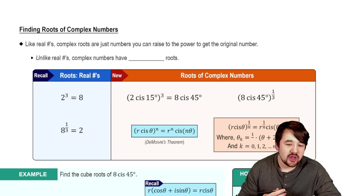
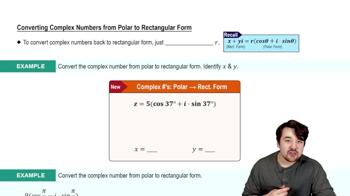
In Exercises 69–76, find all the complex roots. Write roots in rectangular form. If necessary, round to the nearest tenth. The complex fourth roots of 81 (cos 4π/3 + i sin 4π/3)
530
views

 Blitzer 3rd EditionCh. 5 - Complex Numbers, Polar Coordinates and Parametric EquationsProblema 71
 Guida verificata passo dopo passo
 07:37
07:37
 03:58
03:58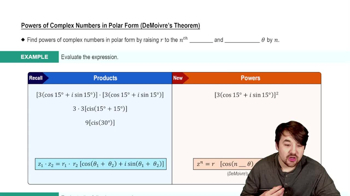 03:41
03:41In Exercises 69–76, find all the complex roots. Write roots in rectangular form. If necessary, round to the nearest tenth. The complex fourth roots of 81 (cos 4π/3 + i sin 4π/3)
In Exercises 69–76, find all the complex roots. Write roots in rectangular form. If necessary, round to the nearest tenth. The complex sixth roots of 64
In Exercises 59–74, convert each polar equation to a rectangular equation. Then use a rectangular coordinate system to graph the rectangular equation.
r = 6 cos θ + 4 sin θ
In Exercises 71–76, eliminate the parameter and graph the plane curve represented by the parametric equations. Use arrows to show the orientation of each plane curve. x = 2t − 1, y = 1 − t; −∞ < t < ∞
In Exercises 59–74, convert each polar equation to a rectangular equation. Then use a rectangular coordinate system to graph the rectangular equation. r = 12 cos θ
In Exercises 69–76, find all the complex roots. Write roots in rectangular form. If necessary, round to the nearest tenth. The complex fifth roots of 32 (cos 5π/3 + i sin 5π/3)