
Domanda del libro di testo
Concept Check Find a solution for each equation. sin(4θ + 2°) csc(3θ + 5°) = 1
722
views

 Guida verificata passo dopo passo
 05:50
05:50
 04:46
04:46 6:36
6:36Concept Check Find a solution for each equation. sin(4θ + 2°) csc(3θ + 5°) = 1
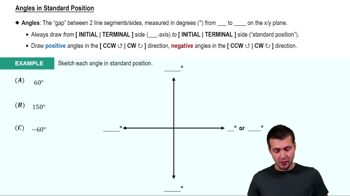
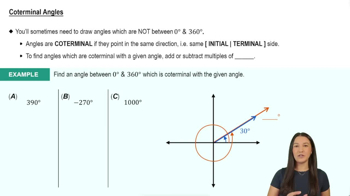
Concept Check Sketch each angle in standard position. Draw an arrow representing the correct amount of rotation. Find the measure of two other angles, one positive and one negative, that are coterminal with the given angle. Give the quadrant of each angle, if applicable. 174 °
Concept Check Sketch each angle in standard position. Draw an arrow representing the correct amount of rotation. Find the measure of two other angles, one positive and one negative, that are coterminal with the given angle. Give the quadrant of each angle, if applicable. ―61 °
Concept Check Sketch each angle in standard position. Draw an arrow representing the correct amount of rotation. Find the measure of two other angles, one positive and one negative, that are coterminal with the given angle. Give the quadrant of each angle, if applicable. ―90 °
Concept Check Sketch each angle in standard position. Draw an arrow representing the correct amount of rotation. Find the measure of two other angles, one positive and one negative, that are coterminal with the given angle. Give the quadrant of each angle, if applicable. 90 °
Concept Check Find a solution for each equation. sec(2θ + 6°) cos(5θ + 3°) = 1