Ch. 1 - Trigonometric Functions
Lial - Trigonometry 12th Edition
Lial12th EditionTrigonometryISBN: 9780136552161, 9780135440780, 9780136881117, 9780135440827, 9780135924891Non è quello che usi tu?Cambia libro di testo
Capitolo 2, Problema 34

Determine the signs of the trigonometric functions of an angle in standard position with the given measure. See Example 2.
―15°

Guida verificata passo dopo passo
1
Identify the quadrant in which the angle lies. Since the angle is -15°, it is a negative angle measured clockwise from the positive x-axis. To find its equivalent positive angle, add 360°: \(-15° + 360° = 345°\). This places the angle in the fourth quadrant.
Recall the signs of the trigonometric functions in each quadrant. In the fourth quadrant: sine is negative, cosine is positive, and tangent is negative.
Determine the reference angle. The reference angle is the acute angle the terminal side makes with the x-axis. For 345°, the reference angle is \(360° - 345° = 15°\).
Use the reference angle to find the values of the trigonometric functions, keeping in mind their signs in the fourth quadrant. For example, \(\sin(-15°) = -\sin(15°)\), \(\cos(-15°) = \cos(15°)\), and \(\tan(-15°) = -\tan(15°)\).
Summarize the signs: sine is negative, cosine is positive, tangent is negative for the angle -15°.

Risposta video verificata per un problema simile:

Questa soluzione video è stata consigliata dai nostri tutor come utile per risolvere questo problema.
Durata del video:
2m

Concetti chiave

Ecco i concetti essenziali che devi comprendere per rispondere correttamente alla domanda.

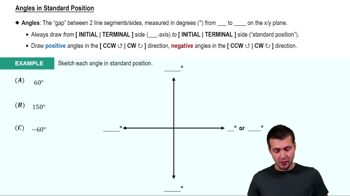
Standard Position of an Angle

An angle in standard position has its vertex at the origin and its initial side along the positive x-axis. The terminal side rotates from the initial side by the given angle measure, positive for counterclockwise and negative for clockwise rotation. Understanding this helps locate the angle on the coordinate plane.
Video consigliato:
Percorso guidato
05:50
Drawing Angles in Standard Position

Quadrants and Sign of Coordinates

The coordinate plane is divided into four quadrants, each determining the signs of x and y coordinates. Since trigonometric functions depend on these coordinates, knowing the quadrant of the terminal side is essential to determine the sign of sine, cosine, and tangent.
Video consigliato:
Percorso guidato
6:36
Quadratic Formula

Signs of Trigonometric Functions by Quadrant

Sine, cosine, and tangent functions have specific signs in each quadrant: sine is positive in QI and QII, cosine in QI and QIV, and tangent in QI and QIII. Identifying the quadrant of the angle allows you to assign the correct sign to each trigonometric function.
Video consigliato:
Percorso guidato
6:36
Quadratic Formula