Ch. 1 - Trigonometric Functions
Lial - Trigonometry 12th Edition
Lial12th EditionTrigonometryISBN: 9780136552161, 9780135440780, 9780136881117, 9780135440827, 9780135924891Non è quello che usi tu?Cambia libro di testo
Capitolo 2, Problema 13

Find the measure of each marked angle. In Exercises 19–22, m and n are parallel. See Examples 1 and 2 .
<IMAGE>

Guida verificata passo dopo passo
1
Identify the given information: lines m and n are parallel, and there are marked angles formed by a transversal crossing these parallel lines.
Recall that when a transversal crosses two parallel lines, corresponding angles are equal, alternate interior angles are equal, and consecutive interior angles are supplementary (sum to 180 degrees).
Use the properties of parallel lines and the transversal to set up equations relating the marked angles. For example, if two angles are corresponding angles, set their measures equal: \(\angle A = \angle B\).
If the problem involves supplementary angles (angles on the same side of the transversal inside the parallel lines), use the equation \(\angle A + \angle B = 180^\circ\) to relate their measures.
Solve the resulting equations step-by-step to find the measure of each marked angle, expressing each angle in terms of known values or variables given in the problem.

Risposta video verificata per un problema simile:

Questa soluzione video è stata consigliata dai nostri tutor come utile per risolvere questo problema.
Durata del video:
3m

Concetti chiave

Ecco i concetti essenziali che devi comprendere per rispondere correttamente alla domanda.

Parallel Lines and Transversals

When two parallel lines are cut by a transversal, several angle relationships are formed, such as corresponding, alternate interior, and alternate exterior angles. These relationships help determine unknown angle measures by establishing equality or supplementary conditions.
Video consigliato:

Angle Relationships

Key angle pairs include corresponding angles (equal), alternate interior angles (equal), and consecutive interior angles (supplementary). Understanding these relationships allows solving for unknown angles when parallel lines and a transversal are involved.
Video consigliato:
Percorso guidato
04:46
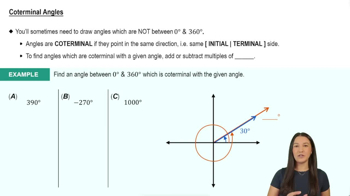
Coterminal Angles

Using Algebra to Solve for Angles

Often, marked angles are expressed in algebraic terms. Setting up equations based on angle relationships and solving for variables enables finding the exact measure of each angle, combining geometric reasoning with algebraic manipulation.
Video consigliato:
Percorso guidato
04:42
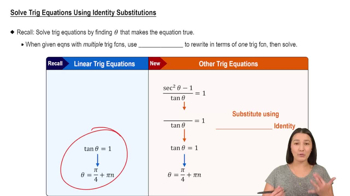
Solve Trig Equations Using Identity Substitutions