Ch. 1 - Trigonometric Functions
Lial - Trigonometry 12th Edition
Lial12th EditionTrigonometryISBN: 9780136552161, 9780135440780, 9780136881117, 9780135440827, 9780135924891Non è quello che usi tu?Cambia libro di testo
Capitolo 2, Problema 29

Find the values of the six trigonometric functions for an angle in standard position having each given point on its terminal side. Rationalize denominators when applicable. (―8 , 15)

Guida verificata passo dopo passo
1
Identify the coordinates of the point on the terminal side of the angle: \(x = -8\) and \(y = 15\).
Calculate the radius (or hypotenuse) \(r\) using the distance formula: \(r = \sqrt{x^2 + y^2} = \sqrt{(-8)^2 + 15^2}\).
Use the definitions of the six trigonometric functions in terms of \(x\), \(y\), and \(r\): - \(\sin \theta = \frac{y}{r}\) - \(\cos \theta = \frac{x}{r}\) - \(\tan \theta = \frac{y}{x}\) - \(\csc \theta = \frac{r}{y}\) - \(\sec \theta = \frac{r}{x}\) - \(\cot \theta = \frac{x}{y}\).
Substitute the values of \(x\), \(y\), and \(r\) into each function to express them in simplest form, and rationalize denominators where necessary.
Determine the signs of each function based on the quadrant where the point \((-8, 15)\) lies (Quadrant II) to finalize the values of the trigonometric functions.

Risposta video verificata per un problema simile:

Questa soluzione video è stata consigliata dai nostri tutor come utile per risolvere questo problema.
Durata del video:
5m

Concetti chiave

Ecco i concetti essenziali che devi comprendere per rispondere correttamente alla domanda.

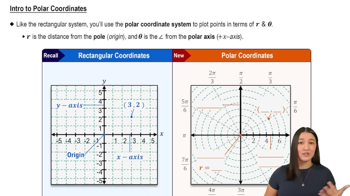
Coordinates and the Terminal Side of an Angle

An angle in standard position has its vertex at the origin and its initial side along the positive x-axis. The terminal side passes through a given point (x, y), which helps determine the angle's trigonometric values by relating x and y to the radius (distance from origin).
Video consigliato:
Percorso guidato
05:32
Intro to Polar Coordinates

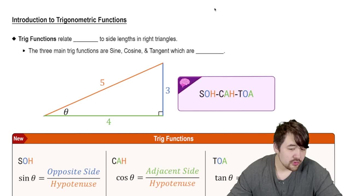
Definition of the Six Trigonometric Functions Using Coordinates

The six trigonometric functions—sine, cosine, tangent, cosecant, secant, and cotangent—can be defined using the coordinates (x, y) of a point on the terminal side and the radius r = √(x² + y²). For example, sin θ = y/r and cos θ = x/r, linking geometry to function values.
Video consigliato:
Percorso guidato
6:04
Introduction to Trigonometric Functions

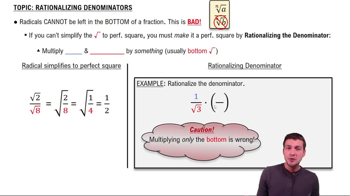
Rationalizing Denominators

Rationalizing denominators involves eliminating any square roots or irrational numbers from the denominator of a fraction. This is done by multiplying numerator and denominator by a suitable radical, ensuring the final trigonometric values are expressed in a simplified, standard form.
Video consigliato:
Percorso guidato
2:58
Rationalizing Denominators